

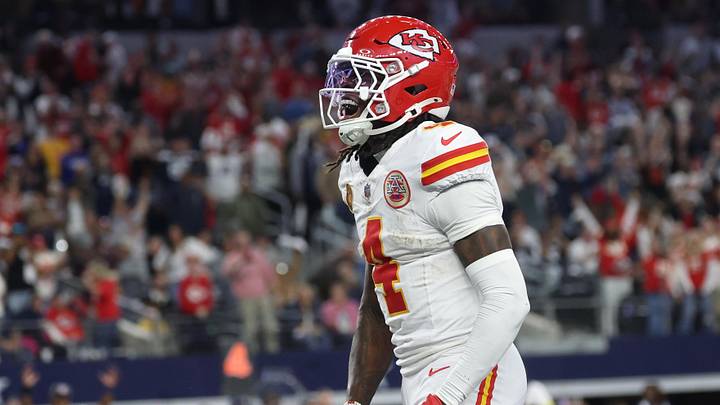
The Kansas City Chiefs found an elite talent when they selected Rashee Rice in the second round of the 2023 draft. If only they could count on that talent to actually get on the field. Rice has played in just 28 of 51 games. He has stated he wants top-of-the-market money but hasn't shown the team enough to trust him with that kind of commitment.
No one would be surprised if he put up a 115-catch, 1,300-yard, 12-touchdown season in 2026. But no one would be surprised if he only played five games as well. What do you do with a player of Rice’s caliber and inconsistency? The Packers may have created the model with Christian Watson.
The answer may live in Green Bay
The Packers had the same problem with their own talented former second-round receiver last year. Watson was entering his fourth season and had also missed plenty of time, 13 of 51 possible games heading into the 2025 season after tearing his ACL in the 2024 finale.
Green Bay's solution was justifiable for both sides. A real compromise. In September of last year, before Watson had played a single down in his return from the ACL, the Packers signed him to a one-year, $11 million extension with $6 million fully guaranteed. The deal kept Watson in Green Bay through the 2026 season at a price that protected the team if his body broke down again, while giving Watson real money to take the pressure off his rehab.
The logic worked for both sides. Watson got additional security before another injury could tank his market in his prime earning years. Green Bay locked in a player they believed in at a number that was a bargain if he stayed healthy and a manageable loss if he didn't. A year later, Watson is producing and the Packers are interested in a long-term extension conversation with their talented pass catcher.
Kansas City should run the same play.
Rice is the same problem with sharper edges
The parallel to Watson is clean in most respects. Both are second-round picks. Rice this year, like Watson last year, is 26 years old. Both flashed elite traits early. Both have availability questions that depress what they could command in a multi-year deal.
But the edges are sharper with Rice. His career availability is worse than Watson's was at signing, having played in 28 of 51 games against Watson's 38 of 51. The off-field component, his felony conviction stemming from the March 2024 high-speed crash in Dallas and the resulting six-game suspension to start 2025, adds a risk variable Watson's profile never had. Rice is on five years of probation. Any further incident reopens the discipline conversation.
The flip side is that when Rice has been on the field, he has been the better receiver. His three-year averages of 2.40 yards per route run and a 17.95% missed tackle rate are elite efficiency markers that hold up against any receiver in the league. He’s still the best option at WR1.
The structure of a potential deal for Rashee Rice
Rice is currently due just $1,635,711 in 2026 on his rookie deal. A one-year, $15 million extension restructures the conversation entirely.
The cash flow would be roughly 55% in 2026 and 45% in 2027. Rice would see $9,250,000 in 2026 cash, with the remainder paid out in 2027. Of the $15 million in new money, $10 million would be fully guaranteed at signing. Both years would include $1,062,500 in per-game roster bonuses, $62,500 per active game, as part of his cash flows. This helps protect Kansas City against more time missed.
That guarantee structure, $10 million fully guaranteed on a $15 million deal, comes in at 66.7%, meaningfully higher than the 55% Watson got from Green Bay. The APY also runs about 36% above Watson's $11 million, which reflects the production gap between the two players when healthy and the volume ceiling Rice carries that Watson does not.
The per-game roster bonuses are the protective layer. If Rice misses time going forward for any reason—suspension, injury, anything—Kansas City saves $62,500 per game off the books. That mechanism addresses the off-field risk directly. It is a clean, conventional structure that many teams use with players who carry much less risk than Rice does. And it’s a structure Kansas City should start using.
The 2027 leverage flip makes this workable from both sides
This is where the deal stops being defensive and starts being strategic. If Rice plays a healthy 2026 and produces at the level his per-route numbers suggest he can, Kansas City has two excellent options.
They can extend him in the 2027 offseason at whatever the market dictates after a clean platform year. A 1,500-yard, 10-touchdown season pushes him into the stratosphere of the $35 million to $45 million APY tier where receivers like Ja'Marr Chase and Jaxon Smith-Njigba live, and Kansas City would be negotiating from inside the building with a year of control still on the books. That year would help make the effective APY—that is, the APY for the total deal, including the year and money remaining on this extension—more palatable.
Or they move him. A 27-year-old WR1 coming off a 1,200-yard season, on a $7.75 million expiring contract, would be one of the most tradable assets in football. Every contender would line up. Kansas City could recoup multiple high picks in a market that values cost-controlled production.
For Rice, the leverage works the same way in reverse. If he plays well and Kansas City doesn't extend him, he hits the trade market with one year of control left, meaning the acquiring team is paying picks and extending him. That would maximize his ability to get to his stated goal of JSN money. Trade leverage increases APY.
A one-year, $15 million extension with $10 million guaranteed protects Kansas City against everything that could go wrong in 2026 and positions both sides to win big if it goes right. Green Bay showed the league how this can work. Kansas City should be paying attention. It’s how they try to get the most out of Rice without risking it all.
 Add us as a preferred source on Google