

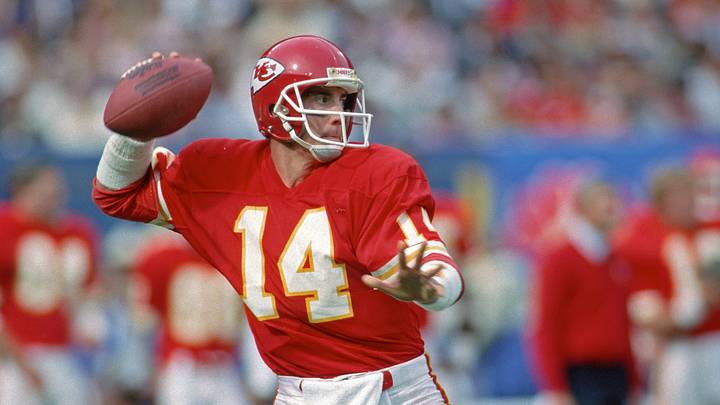
They are the decisions that can change the destiny of an entire franchise.
On one hand, a great draft hit could be the catalyst that leads a team like the Kansas City Chiefs to three Super Bowl championships in five years. On the other hand, a draft bust could lead to years of misery and suffering for a fan base. There’s a lot on the line on draft day.
Each of the Chiefs' players on this list was a bust for a variety of reasons. Some failed to live up to the post-draft hype. Some underperformed their draft slot. Some were just straight-up bad. All of them left their mark on the franchise, even though fans might wish that they hadn’t.
Ranking the top 25 draft busts in Chiefs history
[Author's Note: I need to make a couple of disclaimers before we get started. First, every single person mentioned in this article is a much better athlete than I am. It takes talent, skill, and hard work to make it to the NFL, and every player deserves credit for making it there. Second, this list is just my opinion. You might agree or disagree, and that’s totally fine.]
25. Cliff Frazier, DT (1977, 41st overall)
Cliff Frazier was the Chiefs’ second selection in the 1977 draft, but the 41st overall pick didn’t spend much time in Kansas City. A defensive tackle out of UCLA, Frazier started 12 games and played in 14, but only recorded 1 sack and 1 forced fumble as part of a Chiefs team that was historically bad.
Kansas City had a 2-12 record that year, the fewest wins and the most losses the team had ever had at the time, and an unwanted low point that stood for another 31 years. Kansas City's negative-124 point differential in ‘77 was the lowest across a 48-season span as well.
After a bad year individually and for the team, Frazier was traded away and didn’t play in another NFL game.
24. Turk McBride, DT (2007, 54th overall)
The Chiefs were left with holes on their defensive line after multiple high-profile and high-value picks (some of which will be mentioned later) failed to pan out. Turk McBride was drafted in the second round in 2007 to try to fill some of those voids, but he struggled on some bad Chiefs teams under head coach Herm Edwards.
In a generally underwhelming rookie season, McBride played in 16 games (starting one of them) and had 1 sack, 1 pass deflection and 11 tackles. He started nine games in 2008, and while he forced 1 fumble and had 6 tackles for loss, he had zero sacks.
McBride was cut by the Chiefs and joined the Detroit Lions, where he had 6.5 sacks and 4 forced fumbles in two seasons.
23. Kris Wilson, TE/FB (2004, 61st overall)
The Chiefs are famous for drafting some legendary tight ends, but Kris Wilson will not be remembered as one of them. Kansas City drafted Wilson in the second round out of Pitt, where he set school records for most yards and touchdowns by a tight end, but he didn’t find that kind of success in the NFL.
Used as a TE but also as a fullback, Wilson had 345 yards and 4 touchdowns across four seasons. He played alongside Tony Gonzalez, which no doubt ate into Wilson’s numbers, but his productivity still didn’t match his draft slot. It also didn’t make a ton of sense for the Chiefs to draft a TE that high when they already had a superstar at that position on their roster.
Wilson had three seasons with the San Diego Chargers and one with the Baltimore Ravens after his time in Kansas City.
22. Eddie Freeman, DE (2002, 43rd overall)
Defensive end Eddie Freeman can be remembered as a Chiefs bust for two reasons: First, for being an underwhelming second-round pick, and second, for literally busting his teammate’s face open with a helmet.
Freeman was taken 43rd overall in 2002, the second d-lineman the Chiefs took in the opening two rounds after they drafted Ryan Sims with the No. 6 overall pick earlier on. Neither worked out. Freeman had a promising 4 sacks along with 3 tackles for loss in 15 games as a rookie, but he played just 5 games in 2003 and didn’t have any sacks or TFLs and was later cut.
What Freeman is probably most famous for is an incident that happened before he’d even played a game. Freeman got in a fight with Chiefs teammate John Tait, ripping off the offensive tackle's helmet and hitting him with it. That left Tait with a broken nose and needing 17 stitches. Freeman later played in NFL Europe and the CFL.
21. Harvey Williams, RB (1991, 21st overall)
The Chiefs missed out on a future Hall of Famer when they drafted running back Harvey Williams with the 21st pick in the 1st round back in 1991.
Williams had some initial success, with 594 yards from scrimmage (447 rushing) and 3 touchdowns as a rookie, but his numbers declined from there. He totaled 477 yards from scrimmage over the next two years combined and was never more than a rotational back behind Christian Okoye, Barry Word, and then Marcus Allen.
To make the pick worse, while the Chiefs didn’t need a running back, they did need a new quarterback, since starter Steve DeBerg was 37 years old in 1991. The Chiefs had the chance to take Brett Favre (32nd overall) in the first round, but they opted for Williams instead.
Williams left the Chiefs after three seasons before joining the Raiders, where he had much more success. He had 3,094 rushing yards in five years with the Silver and Black, including a thousand-yard season in ‘95, which is far more production than Kansas City ever got.
20. Felix Anudike-Uzomah, DE (2023, 31st overall)
Felix Anudike-Uzomah’s career is not over, but I think we’ve seen enough—or not enough, technically speaking—to say he hasn’t lived up to his draft spot.
Taken with the 31st pick overall in the 2023 NFL Draft, FAU was meant to help replenish a defensive front that had lost veterans and key pieces like Frank Clark, but he struggled to make an immediate impact. Anudike-Uzomah didn’t start as a rookie, and he had just 3 sacks, 8 tackles for loss, 2 forced fumbles, and 41 total tackles in his first two seasons before missing all of 2025 with a serious hamstring injury.
At 24 years old, FAU is still relatively young, and he's played better in his contract year so far in 2026. However, there's a lot of ground to make up if he wants to live up to the first-round tag. Six of the seven D-linemen taken after Anudike-Uzomah in the second round have more career sacks than he does. That, combined with Kansas City’s pass-rush struggles, has FAU firmly in the bust category, even though his career isn’t over.
19. Glenn Dorsey, DT (2008, 5th overall)
If Felix Anudike-Uzomah is (rightly) considered a bust, then I think Glenn Dorsey, a player drafted even higher with greater expectations and hype, should be too.
Dorsey was regarded as one of the nation's top defensive linemen in the 2008 draft, coming off a senior year that saw him win a national championship with LSU and seven different awards. But after he was taken by the Chiefs with the fifth overall pick, Dorsey was never able to replicate the dominance he had at college with the Tigers.
Dorsey never had more than 2 sacks in a season in Kansas City, and he averaged less than 1 per year across his five years in Kansas City. He started 65 games and had 17 tackles for loss, 1 forced fumble, and 159 tackles.
It wasn’t an awful return, but it certainly was less than what the Chiefs were hoping to get from such a highly-rated prospect. Dorsey ended his career with two seasons in San Francisco.
18. Clyde Edwards-Helaire, RB (2020, 32nd overall)
It feels harsh to call Clyde Edwards-Helaire a total bust, but it’s fair to say Kansas City’s first pick in the 2020 draft didn’t live up to the first-round expectations either. CEH was seen as a “luxury pick” when he was drafted the offseason after Kansas City won Super Bowl LIV, but it was a selection that came back to haunt the team.
Edwards-Helaire had a strong rookie season (1,100 yards from scrimmage, five touchdowns), but injuries slowed him down, and he never hit those same heights again.
To make things even worse, the players drafted directly after CEH—wide receivers Tee Higgins and Michael Pitman Jr.—went on to have better careers at a position the Chiefs ended up needing even more than running back. Kansas City also drafted Edwards-Helaire ahead of future All-Pro and NFL rushing leader Jonathan Taylor.
Edwards-Helaire had 2,610 total yards and 19 total touchdowns in his first four seasons as a Chief, before a brief return to the team in 2025. However, his selection felt like a wasted pick that left the Chiefs with holes at two positions they spent six years trying to fill, one of which is still a problem to this day.
17. Elmore Stephens, TE (1975, 34th overall)
Elmore Stephens might be the most obscure name on this list, but he earned a spot on it for a very good reason: he is the highest NFL draft pick the Chiefs have ever made who never played a game for Kansas City. What an accolade.
The Chiefs took Stephens 10 picks into the second round (34th overall) with their first selection in that year’s draft, but he never took a single snap in a Chiefs uniform.
The entire 1975 draft class was a total train wreck. Of the 11 players Kansas City drafted that year, only one—Morris LaGrand—went on to play at least one game for the Chiefs. The other ten guys never suited up, not even once.
Third-round defensive tackle Cornelius Walker was another high-value swing and miss from a Chiefs draft class that genuinely might be the worst draft class any team has ever had in the history of the NFL.
Unsurprisingly, Kansas City went 5-9 in 1975 and didn’t have a winning record again until 1981.
16. Brodie Croyle, QB (2006, 85th overall)
Brodie Croyle will be remembered as one of the worst and most cursed quarterbacks to ever play for the Chiefs.
Drafted in the 3rd round in 2006 after a prolific but injury-prone college career at Alabama, Croyle had the weight of becoming Kansas City’s first homegrown quarterback to start a game since Todd Blackledge 24 years prior on his shoulders, and he crumbled.
Croyle was meant to inherit the starting job from Trent Green, but a mix of underwhelming play and horrendous injury luck meant he never took the mantle. He started 6 games in 2007 and was QB1 to begin 2008, but he missed 14 games with injury that year and was a backup for the rest of his career.
Overall, Croyle started just 10 games across five seasons with Kansas City and lost every single one of them, giving him the worst win-loss record of any Chiefs QB in history. He threw for 1,669 yards, 8 touchdowns, and 9 interceptions in his career.
15. Skyy Moore, WR (2022, 54th overall)
For me, this is the most frustrating draft miss of the Brett Veach era. Not just because Skyy Moore didn’t work out (for KC), but because of the lead-up to the Chiefs drafting him in the first place.
Some mock drafts had the Chiefs drafting wide receiver help at 30, but they opted for George Karlaftis instead. No problems there, but what happened next was painful.
Kansas City passed on George Pickens initially, but he was still there at their next pick at 50. But the Chiefs traded down to No. 54, and Tyquan Thornton (No. 50), Pickens (No. 52), and Alec Pierce (No. 53) were drafted right in front of them.
K.C. took Moore at 54, but he never caught on offensively and was primarily a returner instead. He started 11 games in three seasons (39 games in total) and had 511 yards, 48 catches, and 2 touchdowns, fewer than all three other receivers the Chiefs passed on.
To his credit, Moore played a key role in Kansas City’s 2022 championship run. A 29-yard punt return set up the game-winning field goal in the AFC Championship Game, and Moore caught a 4th-quarter go-ahead touchdown in Super Bowl LVII. But overall, his tenure was underwhelming, especially compared to the guys the Chiefs could have had instead.
14. Junior Siavii, DT (2004, 36th overall)
Junior Siavii was brought in to try to shore up the horrible defense the Chiefs had in the early 2000s. The defensive tackle was taken early in the second round (36th overall) with Kansas City’s first pick in the 2004 draft, but his production never lived up to the expectations the team put on him.
Mainly seen as a run stopper, Siavii was expected to go as late as the fifth round, but instead was picked almost 100 spots before that by the Chiefs. His production proved how big of a reach that was. He had 15 tackles, 3 tackles for loss, and just 1 sack in his 26 games in red and gold.
Five other defensive linemen—including two defensive tackles—were taken in the second round of the ‘04 draft after Siavii, with four of them recording double-digit sacks. Knee injuries hampered his career in 2006 and he was out of the league for three years after the Chiefs cut him, before spending one season each with the Dallas Cowboys and Seattle Seahawks.
13. Breeland Speaks, DE (2018, 46th overall)
Brett Veach’s biggest weakness as Kansas City’s general manager has been his struggle to draft quality defensive linemen, a problem which began with the first draft selection he ever made: Breeland Speaks.
Veach traded up eight spots to take Speaks in the second round at 46th overall, an eyebrow-raising move for the Ole Miss defensive end projected to go in the third or fourth round.
Speaks made four starts and played in every game as a rookie, but he only collected 1.5 sacks, had 3 tackles for loss, 15 tackles, and 1 forced fumble. Those are underwhelming numbers, especially considering he was the team’s first pick in the draft.
Those would be the only games Speaks ever played in the NFL. He missed the entire 2019 regular season with a serious knee injury, and he was cut by the Chiefs before Week 1 in 2020. He had stints with six other NFL teams, but never played a game for any of them.
Ethan Horton has one of the most bizarre stories of any Kansas City draft bust, which is really saying something. He was the first running back off the board in 1985 when KC drafted him 15th overall, but that’s not the position he became most famous for playing.
Horton flamed out in his one season in Kansas City, starting zero games and putting up just 148 rushing yards (3.0 yards per attempt) and 3 touchdowns. He had 28 catches and 185 receiving yards too, but that wasn’t enough to stop the Chiefs from cutting him.
After a brief stint with the Los Angeles Raiders and a few years out of the league, Horton returned to L.A., where he was reinvented as a tight end and went on to have a successful NFL career. He made a Pro Bowl as a TE five years after Kansas City cut him and ended with 2,360 career receiving yards and 17 touchdowns.
When your first-round RB becomes a better TE at a divisional rival, you bet that’s considered a huge draft bust.
11. Matt Blundin, QB (1992, 40th overall)
Less than a decade after passing over two future Hall of Famers at quarterback, Kansas City whiffed at the position again when they drafted Matt Blundin in the second round in 1992.
The Chiefs needed a young QB to take over the starting job in the early '90s, and they turned to Blundin, despite his middling college career that included limited time as a starter. The decision failed spectacularly.
Blundin played in two games in two years as Kansas City’s backup quarterback. He threw the ball 8 times as a Chief, completing just 2 passes for 15 yards and throwing 1 interception. He had zero career touchdowns.
Blundin’s only other NFL snap came in 1997 when he came in as a third-stringer for the Detroit Lions. His one pass that game was a pick-six, meaning he ended his career with the same number of interceptions thrown as passes completed (two).
10. Mike Elkins, QB (1989, 32nd overall)
Remarkably, Mike Elkins was even worse than Matt Blundin was, which is pretty hard to believe.
Elkins was the second quarterback off the board in 1989, drafted at the start of the second round at 32nd overall. The QB taken before him, Troy Aikman, went on to enjoy a Hall of Fame career, while Elkins... did not.
It was a huge draft miss considering the value of the pick used on Elkins. He played in just one game and threw two passes in his entire career: one was a 5-yard completion, the other, an interception. 1989 was his only year with Kansas City and in the NFL.
Elkins was the meat in a QB draft crap sandwich the Chiefs made over a decade. Another disastrous draft miss in the early '80s led to Kansas City drafting Elkins, and his failure meant they drafted Blundin, another bust, three years later. What a time.
9. Tyson Jackson, DE (2009, 3rd overall)
If you’re going to overpay for a guy in the first round, you better be right. The Chiefs certainly weren’t when they drafted Tyson Jackson with the third pick overall in 2009.
The DE was mocked to go in the mid- to late-first round, but Kansas City reached and selected him at three, a move that clearly didn’t pan out. Jackson was a league-average player, if that, which might be fine for a fifth-rounder, but nowhere near good enough for the third overall pick.
He had five seasons with the Chiefs and played in 74 out of a possible 80 games, starting 55 of them, but his production was hugely disappointing. He had just nine sacks, 12 tackles for loss, and an average of 40 tackles per season.
Jackson took a $10 million pay cut before the 2013 season (his last in Kansas City), which tells you exactly what the Chiefs thought about his level of play. He spent the last three years of his career with the Atlanta Falcons.
8. Jonathan Baldwin, WR (2011, 26th overall)
When the Chiefs drafted Jonathan Baldwin 26th overall in 2011, they were hoping to get a player who could pair with Dwayne Bowe to form a dynamic duo at wide receiver. Instead, they got a player who came nowhere near expectations during his short stint in Kansas City.
There were attitude questions around the first-round pick before the draft. Those concerns were validated when Baldwin injured his wrist in a preseason fight with a teammate.
Once on the field, Baldwin’s production was underwhelming. He had two seasons in Kansas City, putting up 579 yards and just 2 touchdown catches in 10 starts and 26 games. He was traded to San Francisco in 2013 and cut a year later.
In his defense, Baldwin played on some bad Chiefs teams under Todd Haley and Romeo Crennel, and Matt Cassel, Kyle Orton, Brady Quinn, and Tyler Palko were throwing him the ball. But as a first-round flop, it’s hard not to see him as one of the key reasons why Kansas City was so awful, along with those other guys.
7. Brian Jozwiak, G (1986, 7th overall)
The Chiefs spent big on the o-line when they took guard Brian Jozwiak with the 7th pick in 1986, but they got an awful return on their investment.
Jozwiak was a consensus All-American in his college senior year at West Virginia, and he was the second offensive lineman off the board in his draft class. It was hoped he’d boost an offensive line that ranked last in rushing offense in 1985, but he struggled at the pro level.
He was expected to be a first-year starter, but Jozwiak only made three starts during his three years in Kansas City, one in each season, before he suffered a hip injury that ended his career.
In total, Jozwiak appeared in just 28 games for the Chiefs, the fewest of any top-10 draft pick in franchise history, an infamy that has him on this list.
6. Paul Palmer, RB (1987, 19th overall)
It’s no surprise that a former first-round pick who is more famous for saying he’d deliberately fumble the ball than for what he did on the field in his career is on this list.
Paul Palmer was college football’s leading running back in 1986. He broke the record for the most all-purpose yards in a season (2,633) and finished second in the Heisman Trophy voting, which led to Kansas City drafting him 19th overall that offseason.
Palmer was an All-Pro kick returner as a rookie, but he was soon overshadowed by a joke gone bad and another running back the Chiefs took 16 picks after him in the same draft: Christian Okoye.
Okoye and Palmer had similar numbers in their sophomore seasons, but Palmer was sensationally suspended after he “joked” about fumbling the football on purpose to embarrass the coaching staff—comments which contributed to him being cut after the season.
Palmer had 1,245 yards from scrimmage (607 rushing and 638 receiving) and 6 total touchdowns in Kansas City in his two seasons with the team, failing to replicate his college success.
5. Sylvester Morris, WR (2000, 21st overall)
It’s impossible to consider a first-round draft pick who had just one season on the field as anything other than a draft bust, even if injuries were to blame for their struggles.
Kansas City took Morris, an athletic wide receiver out of Jackson State, at No. 21 overall in the 2000 draft, making him just the third first-round WR the Chiefs had ever selected in the draft at the time.
It looked like a good move early on. Morris had 28 catches, 678 yards, and 3 touchdowns as a rookie while he started 14 games. It didn’t last. Knee injury after knee injury kept Morris sidelined, and he never played in an NFL game again after his rookie season.
The three wide receivers taken in the second round by other teams in that same draft all had double-digit touchdowns and more than 2,800 career receiving yards.
4. Percy Snow, LB (1990, 13th overall)
Percy Snow is a classic example of a fantastic player whose career was totally derailed by injury.
An All-American at Michigan State, Snow won a Butkus Award as the top college linebacker in the country and later became a College Football Hall of Famer, with the Chiefs drafting him 13th overall in 1990.
Initially, it seemed like they’d found a future star. Snow started 14 games, had 2 sacks, 1 interception, and was named to the Pro Football Writers of America’s All-Rookie team that year. But an injury ruined everything.
Snow broke his ankle in a moped crash that offseason and was never the same again. He missed all of the 1991 season and made just one start in 1992 without recording a sack. After one year with the Chicago Bears, he was out of the league.
The injury wasn’t Snow's or Kansas City’s fault, but it clearly changed the course of his career and turned the Chiefs' first pick into a bust. Based on his success in college, I think Snow is the biggest “what could have been” player on this list, which is why he is so high up.
3. Ryan Sims, DT (2002, 6th overall)
Ryan Sims might just be the biggest letdown Kansas City has ever had when it comes to post-draft excitement and hype vs. on-field reality.
Sims was selected in the 2002 draft at a time when Kansas City’s defense needed improvement. He and college teammate Julius Peppers were the top two d-line prospects that year, so it seemed like the Chiefs hit the jackpot when they traded up two spots to take Sims sixth overall.
But Sims’ numbers were bad—really bad. He went sackless in three of his five seasons in Kansas City and totaled just 5 sacks overall, with 1 interception and 1 forced fumble. Instead of improving with Sims, Kansas City’s defense got even worse, ranking in the bottom 10 for total yards and points allowed the entire time he was with the team.
In a sliding doors moment, the Chiefs almost missed out on Sims while trying to pull off a trade with the Dallas Cowboys. Had K.C. stayed at eight and not moved up, they might have drafted future Hall of Fame DE Dwight Freeney (Indianapolis Colts) instead.
2. Trezelle Jenkins, T (1995, 31st overall)
I think Trezelle Jenkins is the worst first-round draft pick in Chiefs history.
A tackle taken 31st overall in the 1995 draft, Jenkins only played 9 games for Kansas City across his three-year career. He made just one start in 1997 but committed 2 penalties and was benched before being cut at the end of the season.
What made the pick so egregious was that it was a huge reach at a position the Chiefs didn’t even need to address. Jenkins was projected to go in the mid-to-late rounds, but Kansas City inexplicably took him at the tail end of the first. The Chiefs already had a strong offensive line, too. They were top-six in fewest sacks allowed from 1995-1997 without having Jenkins on the field.
Kansas City traded to move down from No. 19 to 31 in the draft that year, with three tackles, all of whom had better careers than Jenkins, going in between. After being let go by Kansas City, Jenkins had tryouts with the New Orleans Saints, Minnesota Vikings, and the XFL’s San Francisco Demons, but he couldn’t play his way onto any of their rosters.
1. Todd Blackledge, QB (1983, 7th overall)
Todd Blackledge is quite simply the biggest draft miss in Kansas City Chiefs history.
A national champion with Penn State and winner of the Davey O'Brien Award as the nation's top college quarterback, Blackledge was taken seventh overall in the 1983 draft. The pick was a total disaster.
Blackledge never started a full season for Kansas City, threw more interceptions (32) than touchdowns (26), had a 49 percent completion percentage, a 62 passer rating, won just 13 games as a starter, and never came close to a Pro Bowl.
Those numbers alone make him worthy of being considered a bust, but what hurts the most is the list of players Kansas City could have had instead of him. The Chiefs passed on future Hall of Famers Dan Marino (Miami Dolphins) and Jim Kelly (Buffalo Bills) to take Blackledge, raising the biggest “what-if” in Chiefs history. Could Marino or Kelly have led Kansas City to an elusive second Super Bowl title? Could they have gotten a team that made seven-straight playoff appearances over the hump? We’ll never know.
Of course, the Chiefs would go on to lose to both Marino and Kelly twice in the playoffs, falling to the Dolphins in 1990 and 1994, and the Bills in 1991 and 1993, with the ‘93 loss in the conference championship game denying Kansas City its first trip to the Super Bowl in 24 years.
Other first-round quarterbacks from ‘83, Ken O'Brien (New York Jets) and Tony Eason (New England Patriots), also both had better careers than Blackledge, making him the worst pick in a loaded QB class.
We’ve seen firsthand that a first-round quarterback can alter the fate of a franchise. Blackledge couldn’t, and was instead part of the reason why Kansas City became synonymous with playoff futility. That draft miss was the last time for 35 years that the Chiefs would draft a QB in the first round. Fortunately, that one worked out a little bit better.
 Add us as a preferred source on Google