

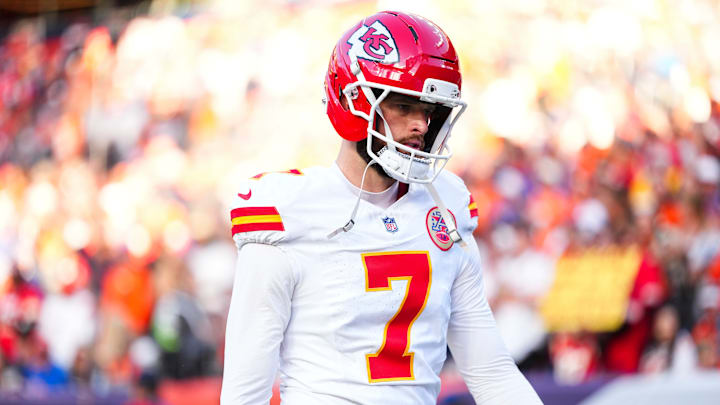
The Kansas City Chiefs have a problem at kicker.
It’s a statement that has been true all season, but the biggest red flag of the entire year came at the end of Sunday’s must-win game against the Los Angeles Chargers. After Gardner Minshew’s final pass toward Travis Kelce was intercepted, ending the game and eliminating Kansas City from the playoffs, a thought immediately came to mind: Where was Harrison Butker?
Why did the Chiefs not turn to their $25,000,000 kicker with the game (and their entire season) on the line? Why did they instead put the ball in the hands of a backup quarterback who, prior to that moment, hadn’t thrown a single pass all season?
I think it highlights an overarching issue the Chiefs have with Butker that could present a huge problem going forward: They don’t trust him. Or, if nothing else, their confidence in Butker clearly isn’t as high as it once was.
Butker has been lights out throughout his career. No matter his regular-season form, he has always made the biggest kicks on the biggest stage when Kansas City has needed him most. So why, in the biggest spot of 2025, did the Chiefs not turn to him?
The Kansas City Chiefs’ late-game choice revealed a troubling lack of trust in the NFL's highest-paid kicker.
With the game on the line, who would you trust more: your backup quarterback, who hasn’t played all season and has just been thrust into the huddle on a do-or-die drive, or the highest-paid kicker in the NFL? The answer should be obvious. The fact that it wasn’t—or that the Chiefs went against it—highlights the extent of the problem.
To be clear, it would have been a difficult and long kick, likely 58 yards at least. But why are you paying your kicker more than $6,000,000 a year if he’s not going to at least attempt a kick like that? Butker’s average salary is more than five times what Minshew is being paid this year. Isn’t that an indicator that he should be the more trustworthy option?
Of course, there are other factors at play. It was second down, there were 20 seconds left, and the Chiefs still had a timeout. They weren’t forced to kick from that spot, so it made sense to try to gain extra yards. On top of that, there was a delay-of-game penalty on the snap immediately before Minshew’s interception that pushed Kansas City back five yards.
But the play call indicated the Chiefs thought they needed a big chunk to get inside Butker’s range. They took a deeper shot into double coverage rather than running a short pass or even a run to gain four or five yards.
The distance is, of course, the biggest obstacle. After his pregame and halftime practice kicks, Butker would have told the coaching staff what his range was in each direction based on the conditions. Maybe he said anything beyond 50 yards toward that particular end zone was out of his range. Maybe the Chiefs simply decided they didn’t want to take the chance on a field goal from the 39-yard line.
Either way, and no matter the reasoning, I keep coming back to one central hang-up: why are you paying a kicker the most money at his position if you aren’t going to have him kick in that spot? Butker made a 59-yarder against the Chargers in Brazil in the season opener, a 56-yarder at Arrowhead against the Eagles in Week 2, and a 54-yarder when the Chiefs played the Giants in Week 3.
Despite his accuracy struggles, he’s clearly still got a strong leg. But since missing a 56-yarder against the Ravens in Week 4, Butker hasn’t had a single attempt from 50-plus yards. Nine weeks.
Sure, the Chiefs might not have had many opportunities to attempt field goals from that range, and we know Kansas City has been more aggressive on fourth down, especially around midfield. But that extra aggression could very well be linked to a lack of trust in the kicking game.
Butker’s form has unquestionably been poor. He’s made 84.6 percent of his field goals this season, which is below league average and the third-lowest mark of his career. That figure is just 0.6 percent better than his conversion rate last year (84.0 percent), and his extra-point percentage—87.9 percent—is the lowest of his career and ranks 23rd in the league. Those aren’t good numbers. They’re even uglier when you factor in what Kansas City is paying for them.
Honestly, given the way the season has gone, I don’t think I would have expected Butker to make that kick even if the Chiefs had gone to him. But if that’s true—and the Chiefs feel the same way—a $5,805,000 base salary is an awful lot to pay a kicker you don’t fully trust, can’t rely on for long kicks, and who has struggled to make shorter ones as well.
The Chiefs should have trusted their star kicker, who is being paid millions of dollars to make field goals in moments exactly like this, instead of a backup quarterback who was in the game for five plays. The fact that they didn’t speaks volumes.
Kansas City won’t cut Butker, at least not yet. He carries a $10,000,000 dead cap hit next season, and it would cost the Chiefs money to remove him from the roster.
Paying top dollar for a kicker who isn’t performing and doesn’t appear to be trusted is a big problem. The Chiefs are going to have to solve it.
 Add us as a preferred source on Google