

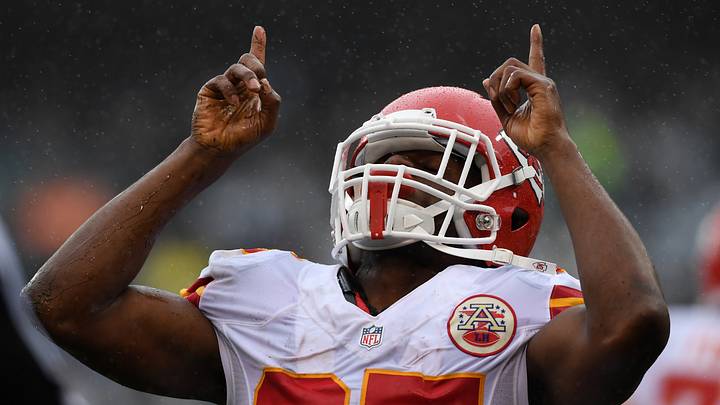
Every year, the Pro Football Hall of Fame grows little by little, usually inducting two or three no-brainers and a few players who have been waiting for their time to come. There are arguments for so many players, recent and beyond, but one player who should be considered over a few other candidates is Chiefs legend Jamaal Charles.
Charles, who played nine of his 11 seasons in Kansas City, has been up for the Hall of Fame since 2024 but has failed to reach the final 50 being considered. That became true once again on Tuesday as the list of the final 52 players being considered was released, roughly three months before final decisions are made.
Four former Chiefs made the list this year, but not Charles. Otis Taylor (1965-75), the legendary wide receiver who flashed for Kansas City, is on to the next stage of voting. Cornerback Albert Lewis (1983-93) is also on the list alongside LeSean McCoy and Terrell Suggs, who only wore red and yellow during the 2019 Super Bowl championship season.
Surely Charles has an argument over McCoy alone, right? Especially considering how little McCoy actually contributed to the Super Bowl run throughout the regular season and postseason.
Either way, Charles' career is teetering on the edge of being Hall of Fame-worthy in the eyes of voters, but it should not be in question when looking at his career as a whole.
Charles was an unstoppable force for years
Not counting the 2011 season, 90% of which he lost due to a torn ACL, Charles was nearly impossible to stop between 2009 and 2014. During that time, he made four Pro Bowls (2010, '12-'14) and was named a first-team All-Pro twice (2010, '13).
He led the league in yards per rush attempt (5.9) in 2009 and steadily improved to nearly seven yards gained every time he attempted a run just two years later before his injury. And two years after that, Charles tied Marshawn Lynch (who did make the final 52 this year) for the most rushing touchdowns (12) in 2013, the same year Charles led the league in total touchdowns (19).
These five seasons are the largest component of his 5.4 career yards-per-carry average, an NFL record that still stands among all running backs with at least 1,000 carries.
Those five seasons also saw Charles earn Offensive Player of the Week honors seven times, finish second in rushing yards in 2010, and finish second in total yards from scrimmage in 2013. They witnessed him take a kickoff 97 yards to the house to open the game and saw him become the only running back in NFL history to record four receiving touchdowns and 190-plus receiving yards in a single game (below). He'd end the game with five total touchdowns, tied for the second-most all-time by a running back.
Remember when Jamaal Charles scored five touchdowns against the Raiders in 2013? pic.twitter.com/9NbvRGib9Q
— Marcus Mosher (@Marcus_Mosher) June 26, 2022
Sadly, most of these outstanding, record-breaking performances came on subpar teams that never found ways to win on a consistent basis. Some of his best statistical seasons were buried beneath 2-14 and 4-12 seasons.
Outside of one fluky 10-6 season in 2010, arguably Charles' best season, he didn't experience a record above .500 at the end of the year until his sixth season. These below-average records are likely one of the few arguments against Charles among voters in Canton.
Charles' case against the rest of the crop
It's not insane to say that Charles is more deserving than some of the other names on the final list of 52 players. One could even argue that Charles is superior to some backs who are already in Canton. But when it comes to the rest of this year's list, it becomes increasingly disheartening to not see Charles' name above some of these others.
For starters, Charles has as many first-team All-Pro selections (two) as Hall of Famer Jerome Bettis and more than Hall of Famers Curtis Martin, Tony Dorsett, and John Riggins.
Charles finished his career with 7,563 rushing yards, not entirely well-manicured for Canton, but Charles was at the forefront of pass-catching running backs. His receiving production especially ramped up when Andy Reid and Alex Smith came to town in 2013, immediately ratcheting up his average of 318.3 receiving yards per year to 693 yards through the air in just 15 games. He'd finish his career with nearly 2,600 receiving yards.
Add on the 1,246 kick return yards, and Charles' grand total is 11,402 all-purpose yards throughout his career. That is more than Shaun Alexander, the Seahawks legend, who finished his career with 10,981 and also advanced in the Hall of Fame voting.
Alexander, McCoy, and Lynch sit and wait for their fate in Canton alongside Frank Gore, Adrian Peterson, Ricky Watters, and Fred Taylor. Charles has more Pro Bowls (4) than Alexander (3) and Taylor (1). He has more first-team All-Pro selections (2) than Alexander (1), Lynch (1), Watters (0), and Gore (0). And, amazingly, Charles has more receiving touchdowns (20) than all seven backs who finished ahead of him this year.
The obvious rebuttal for most of these players is the accolades that they achieved in the postseasons and offseasons that Charles could not reach with such lackluster teams for much of his career. For instance, Peterson (2012) and Alexander (2005) both have MVP awards as running backs. That is a huge boost.
Then there are the Super Bowls, which Charles could never even sniff outside of two one-and-done playoff appearances (2010, '13) and a third divisional-round loss following the 2016 season in which he was unable to play due to knee surgery. Meanwhile, Alexander and Gore played in Super Bowls but couldn't finish on top like Lynch and Watters both did once.
Then there is McCoy, who technically is a two-time Super Bowl champion, having been a healthy inactive on the sideline for both Super Bowls LIV and LV.
This continues to be the biggest hex on Charles' chances at the Hall of Fame: his team's lack of relevance during his prime and its lack of reliance on him during its best years late in his career. Unlike most of the seven other backs, who were all heavily needed when their teams were at their most successful, Charles' immense talent was wasted on the worst Chiefs teams.
If only Andy Reid showed up a few years earlier.
Next year will be Charles' fourth year waiting to get the gold jacket. It may never come for him, which would be a shame, but if it does, it would be well deserved and would act as the perfect trophy for lifting the spirits of Chiefs fans during their years of despair under the likes of Romeo Crennel, Todd Haley, and Herm Edwards.
Charles had a slim chance this year, largely due to it being Peterson's first year of eligibility, but hopefully, within the next few years, the running back room will weed out the undeserving and propel Charles above them, where he rightfully belongs.
 Add us as a preferred source on Google