

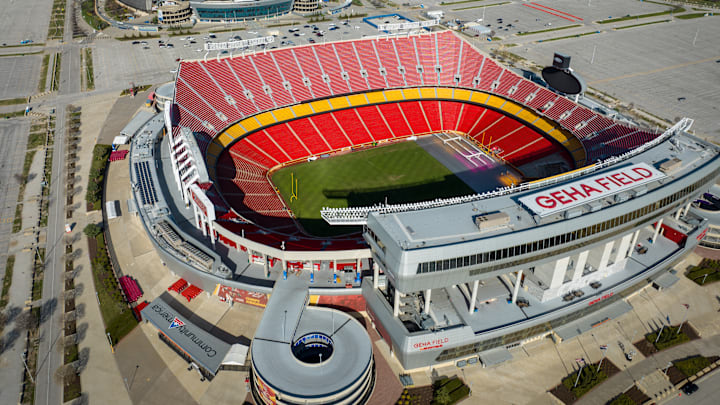
With Monday's expected announcement, it’s all but official that the Kansas City Chiefs will be leaving Arrowhead Stadium for a new stadium in Kansas.
Per Kansas City Star reporter Sam McDowell, the Chiefs have "informed administrative officials that they will announce their move to Kansas." This story has been long-evolving and complex, but the end result is still hard to stomach for many involved.
Unfortunately, Chiefs fans are caught in the crossfire, like kids watching their parents fight. Right or wrong, for better or worse, the Chiefs are leaving Missouri—and the reason why has no simple answer.
The plan was destined to fail
Many critics of the proposed stadium vote in April of 2024 believe the Chiefs never really wanted to renovate Arrowhead. While the renderings and additions were certainly not a dramatic change, there’s one factor that is frequently overlooked. The Chiefs and Kansas City Royals being on the same lease—and in turn the same sales tax vote—is not only unique, it’s the only arrangement of its kind. No other city has two professional sports teams existing on the same sales tax. Because of that, it really limited what could be done without increasing the tax. Jackson County overwhelmingly voted down an extension of the existing sales tax. Adding an increase to the tax would’ve made the plan even more unrealistic politically.
Looking back at the failed vote, the Kansas City Royals certainly have a hand in this. From day one, the Royals seemed behind on this project, and they missed deadline after deadline to get the stadium plan finalized. The final proposed location saw changes to the proposition during the week of the vote. That sort of instability had every right to put doubt in the minds of Jackson County voters. That, combined with an underwhelming Arrowhead renovation, led to a dramatic defeat.
The realities of political posturing
No doubt about it: There was a largely political element to this story. It came from all angles. On the surface level, there’s a long, socially accepted practice of rich billionaires coming to the tax-paying common man, asking for money to build the privately owned stadiums that they profit from, with the promise of immeasurable financial impact and the rooting interest of a metro area. Meanwhile, there is a large part of the public that will, without a doubt, never vote to give a billionaire a cent of tax money no matter how great the proposition is.
This is where political activist groups that played a major part in April's election made their voices heard. Several more urban areas in the country have already seen team owners not even try to get tax money for their stadiums because the public just won’t support it.
There was an added layer with Jackson County representative Frank White, who was already in a tenuous situation with the city over personal property tax and other issues. It created an ecosystem where not only was it the classic “rich man vs. poor man” battle, but also a battle among those who stood to benefit most from the vote (Jackson County voters).
Because of the geographical environment of Kansas City, it was only a matter of time before the Chiefs and/or Royals began to use the state of Kansas as leverage. All negotiations need leverage and a due date, and the Chiefs used Kansas as the threat of “or else” against Jackson County. The unique success of STAR bonds with the Kansas Speedway project also positioned Kansas to offer something that Missouri could not. This leverage also didn’t stop Jackson County voters, as it was fair for them to conclude that it was time for the other part of the city to start sharing the burden of two major sports franchises.
Safe to say it’s official. This is what you now see as soon as you walk into the state office building. Looks like the Chiefs are moving from Missouri to Kansas. @KSHB41 pic.twitter.com/iuzoq7f6Gh
— Kevin Holmes (@kholmesKSHB) December 22, 2025
What might've been for the Chiefs?
Plain and simple: if Jackson County voters truly valued having the Chiefs and Royals in their county, they should’ve voted yes. While there are many fair and valid criticisms of the proposition put forth in April 2024, there was a need for urgency. The misstep was believing that the Chiefs—and maybe the Royals—would wait around for Jackson County and the State of Missouri to get their house in order. Each time you see a franchise move across state lines or change metro areas, you see another state eager to snatch up a billion-dollar corporation. Any thought that voting “no” was going to force Clark Hunt or John Sherman into paying for their own stadium was very misguided.
Another one added to the NFL teams that (will have) played in Missouri:
— Harold R. Kuntz (@HaroldRKuntz3) December 22, 2025
St. Louis Cardinals ---> Arizona
St. Louis Rams ---> Inglewood, CA
Kansas City Chiefs ---> Kansas City (KS) Chiefs
Ultimately, the failed vote might have been the best thing for both franchises. Now on separate deals, the stadiums will have more long-term viability and a longer path to economic impact for the city. It’s hard to come to a full conclusion on the stadium issue without knowing what ends up happening to the Royals. However, we do now know the Chiefs are leaving Arrowhead.
A beloved icon of football will eventually be a pile of rubble. Home to iconic moments, the loudest fans in football, and the best-smelling parking lot in the country, it will eventually be just memories. However, there needs to be some context to this thought. Until a kid from Texas Tech was drafted, Arrowhead was mainly a home of heartbreak for Chiefs fans. The venue was iconic and had some charm, but the idea that it was a sacred cathedral of football was far from accurate.
Arrowhead is concrete, metal, grass, and plastic. Chiefs Kingdom is comprised of people like you and me: People who arrive 12 hours early to wait in line for football games when the high temperature is in the single digits; people who made John Elway ask officials to penalize the fans for being too loud; and people who treat cooking in a parking lot as an art form. Chiefs Kingdom is what makes Arrowhead special, not a bland spot off I-70 next to Raytown, Missouri.
A new domed stadium provides opportunities for the city that have never existed before: Super Bowls, Final Fours (which Kansas City has a long history of hosting), College Football Playoff games, and year-round appeal to countless other events. This city is already punching above its weight by hosting part of the largest sporting event in the World Cup. These are the types of events that can help our city and our team grow. At the end of the day, the new stadium will never be Arrowhead, and there will be a change to the feel of the venue. However, there will not be a change in the Kingdom.
 Add us as a preferred source on Google