

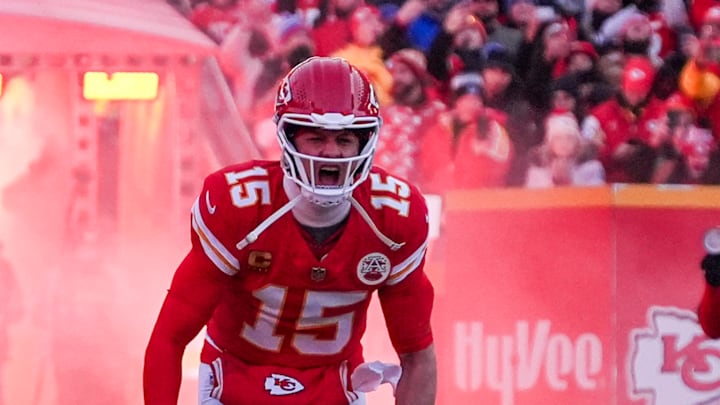
Long before the green-and-white confetti fell to the turf at Caesar’s Superdome in New Orleans, the Kansas City Chiefs already knew that the results of Super Bowl LIX meant more than just one loss—or even just one Super Bowl loss.
The Chiefs’ opponent that day was greater than just the Philadelphia Eagles. Thirty-one fanbases and over 50 years of history were stacked up against the Chiefs on that fateful day, and though Kansas City was just 60 minutes away from becoming the first team in league history to win three consecutive Super Bowls, they fell just short.
Los Angeles Lakers coach Pat Riley coined the phrase “three-peat” in the 1980s, a fusion of the words “three” and “repeat.” It became a championship of championships, a rite of passage into all-time greatness. To not only win one season’s championship, but three consecutive, meant a new kind of legendary greatness. Ironically, Riley’s Lakers did not achieve the feat, as they came up just short in their pursuit of a third ring. In the 1990s, multiple teams in different sports came close, and the phrase became a part of typical sports nomenclature. Phil Jackson’s Chicago Bulls did achieve the three-peat. Then they did it again. Then Joe Torre’s New York Yankees did the same in the late ’90s.
What does the three-peat hangover look like? Let's look back at NFL history to see.
Pursuit of the achievement was not immune to the NFL in the ’90s. The San Francisco 49ers were in hot pursuit of a three-peat of their own. Then the Dallas Cowboys came close to one. A few years later, the Denver Broncos were knocking on the door. Since the year 2000, only one team besides the 2024 Kansas City Chiefs had a shot at a three-peat: the 2005 New England Patriots.
But none of them were able to achieve it.
And that is where the NFL is different. So much of the league is structured around the pursuit of parity. On top of that, you have the fatigue that comes from playing into late January and early February for three years in a row, and eventually that will take its toll on any roster. There is also the fact that the NFL’s salary cap restricts team spending more than other sports. MLB’s luxury tax is a soft cap that allows teams to overspend as long as they pay double to the league office, and it is commonplace for big-market clubs to spend significantly over the cap. The Los Angeles Dodgers exceeded the cap by over $100 million in 2024. It is common for some teams to have payrolls that are double or even triple the amount of their opponent.
Football is also the consummate team sport. Unlike basketball, where Michael Jordan was one of five players on the floor (almost all the time), Patrick Mahomes is one of 11 on the field for his team—when they are on offense. Defense, of course, employs 11 more players, and that does not even factor in special teams. Bobby Witt is the key bat in the middle of the Kansas City Royals’ lineup, and he is also the key defender in the center of their defense. Football players just do not have that level of impact on their team when they only play on one side of the ball. For this reason, it is more likely that parity ripens in football.
Lastly, there is the “circled name on the calendar” factor. When you’re at the top of the mountain, everyone sees your name on their schedule. And everyone wants to be the one to knock off the big dog. There is no doubt that in the last eight years, teams like Buffalo, Cincinnati, and Baltimore have looked for Kansas City’s name first when annually glancing at their upcoming schedule. The team at the top is getting everyone’s absolute maximum preparation and effort, week in and week out.
The Green Bay Packers
The 1969 Packers were a dwindling dynasty, having indeed won three consecutive championships, as their fanbase will proudly tell you. But specific to the post-AFL–NFL merger Super Bowl era, Green Bay won Super Bowls I and II, and then legendary head coach Vince Lombardi retired. The Packers came up short in 1968, and 1969 was another disappointing third-place finish under coach Phil Bengtson.
Having lost star left tackle Bob Skoronski to retirement, the Packers were a shell of their former selves, with stars like Ray Nitschke, Herb Adderley, Willie Davis, and Jerry Kramer playing on their last legs. Quarterback Bart Starr shared a big chunk of the season with backup Don Horn, and Starr played just one full season after that. The Packers missed the playoffs entirely.
The Miami Dolphins
The 1975 Miami Dolphins, led by Don Shula, were coming off a disappointing loss to Ken Stabler’s Oakland Raiders in their pursuit of a third straight Super Bowl. Running backs Jim Csonka and Jim Kiick had departed. So had wide receiver Paul Warfield. Linebacker Nick Buoniconti was out for the season with an injured thumb.
But the Dolphins still had quarterback Bob Griese, who led Miami in a valiant pursuit to get back to the playoffs until he suffered a season-ending broken toe. Two late-season losses to the Baltimore Colts foiled Miami’s hopes of getting back to the postseason. The Colts had started the year 1-5 but then ripped off nine straight wins to edge the Dolphins out of the division title and the playoff field.
The Pittsburgh Steelers
The 1977 Pittsburgh Steelers entered the season on a mission after a disappointing loss at the hands of—once again—Ken Stabler and the Raiders. Questions swirled around 29-year-old quarterback Terry Bradshaw (he broke his big toe while chasing his dog in July before the season began) and whether he could lead Pittsburgh back to glory.
After a 4-4 start, the Steelers finished on a tear, winning five of their last six games and winning their division. But the season once again ended in disappointment with a divisional-round loss at Denver. A year later, the 1978/1979 Steelers would give themselves another shot at a three-peat, winning Super Bowls XIII and XIV.
The 1980 attempt at a three-peat started off nicely, as the Steelers defeated Houston (who had just traded for a new quarterback—Stabler!) in the opener. But as the season went along, the team’s age began to show. In spite of their 4-1 start, the Steelers’ second quest to three-peat ended in a disappointing 9-7 season.
The 1981 Pittsburgh Steelers returned much of their aging offensive core but had lost defensive linemen Joe Greene and L.C. Greenwood. Two failed attempts at a three-peat notwithstanding, they were still the winners of four of the last six Super Bowls. The Steelers still made a valiant effort in 1981, beginning December at 8-5 and in the thick of the playoff hunt when the team traveled to Oakland to take on the Raiders (not quarterbacked by Stabler). Pittsburgh got off to an early lead, but in the second quarter, Bradshaw broke his throwing hand on the helmet of a blitzing linebacker. Backup signal caller Mark Malone finished the game (and the rest of the season) for the Steelers, who lost in heartbreaking fashion to the Raiders that day and lost the next two games to finish the season 8-8.
The San Francisco 49ers
The 1991 San Francisco 49ers entered their season in disarray. After winning Super Bowls XXIII and XXIV and cruising through the 1990 regular season at 14-2, the three-peat appeared to be well within their grasp. But their run had come to a crashing halt at Candlestick Park against the New York Giants in the NFC Championship Game. Nursing a four-point lead late in the game, tragedy struck when 49ers quarterback Joe Montana was violently sacked on third down and was injured on the play. The Giants stole the game with two late field goals, and San Francisco’s attempt at a three-peat ended in disaster.
As the 1991 season began, Montana suffered an elbow injury in a preseason game against the Kansas City Chiefs. The star quarterback was thought to be able to make it back to the lineup but did not heal properly and missed the entire season. With Steve Young at the helm, the team limped to a 4-6 start before stringing together six straight wins to finish 10-6. That was just enough to tie with the Atlanta Falcons in the NFC West standings (yes, Atlanta used to be in the NFC West), but the 49ers lost the tiebreaker and missed out on a playoff berth. In hindsight, 1991 was the only season in a 16-year span in which San Francisco was out of the NFC playoff field.
In 1994, the NFL implemented the salary cap. More on that later.
The Dallas Cowboys
The 1995 Dallas Cowboys are the only team to win a Super Bowl after failing at the three-peat. The year prior was the first year of the Barry Switzer era, as Jimmy Johnson had stepped down after winning Super Bowls XXVII and XXVIII. Dallas’s attempt at a three-peat during Switzer’s first season as head coach ended with a loss to Steve Young’s 49ers, but the 1995 version of the Cowboys was just too strong to be held back. The franchise signed star cornerback Deion Sanders from San Francisco, and the offensive trio of Troy Aikman, Emmitt Smith, and Michael Irvin led the Cowboys back to another Lombardi Trophy.
The Denver Broncos
The 2000 Denver Broncos were in a full-on rebuild. The 1997–1998 rosters that had won consecutive Super Bowls seemed almost completely dismantled. Quarterback John Elway had previously retired after his second Lombardi Trophy, and when the 1999 team lost running back Terrell Davis and tight end Shannon Sharpe for most of the season, the attempt at a three-peat had completely derailed. Sharpe moved on to the Ravens. Davis was still hurt. The team entered 2000 with its Super Bowl coaching staff still intact, but the tandem of Brian Griese and Gus Frerotte at quarterback limited the Broncos, who struggled to muster an 11-5 wild-card team that got pummeled in the opening round at Baltimore. Sharpe’s miracle 58-yard touchdown (make sure to watch the replay at the 1:45 mark if you’d like to see Chiefs nemesis Bill Romanowski get de-cleated) put the final nail in the coffin of any hope of the Broncos returning to dominance in the AFC.
The New England Patriots
The mid-2000s New England Patriots, in hindsight, are just one chapter in the story of the NFL’s longest dynasty. At the time, the team’s coaching staff was undergoing serious transition. Offensive coordinator Charlie Weis and defensive coordinator Romeo Crennel had both been hired away as head coaches after winning back-to-back Super Bowls (Weis to Notre Dame, Crennel to the Cleveland Browns), and that led to a season of transition when the team was trying to win a third straight Super Bowl. The defense quickly found itself without star cornerback Ty Law (released), linebacker Tedy Bruschi (stroke), and safety Rodney Harrison (season-ending injury in Week 3). The attempt at the three-peat in 2005 fell apart before it really had a chance. However, the four quarterbacks in the AFC East were Gus Frerotte, Kelly Holcomb, Brooks Bollinger, and Tom Brady—so you already know who won the division.
Despite making the playoffs, the Patriots’ attempt at the first-ever three-peat ended in a divisional-round loss on the road to Jake Plummer and the Denver Broncos. The 2006 Patriots, on the heels of their failed three-peat, roared to exciting victories (35-0 over Brett Favre, Aaron Rodgers, and the Green Bay Packers) and suffered puzzling losses (21-0 at Miami and losing at home to the Jets). When it mattered most, they leaned into Brady and got the job done. They won six of their last seven and streaked to a 12-4 record, making it all the way to the AFC Championship Game before losing a thriller to Peyton Manning and the Indianapolis Colts.
That was the list, for 20 years. Eight teams had won consecutive Super Bowls, and all eight had failed at winning a third in a row.
Parity continued to temper the league. Thirteen different franchises won the next 20 Super Bowls, but no team even won two in a row until Chiefs quarterback Patrick Mahomes connected with wide receiver Mecole Hardman in overtime to defeat the San Francisco 49ers in Super Bowl LVIII.
The 2024 Chiefs set their sights on the three-peat, and in making it to New Orleans for Super Bowl LIX against the Eagles, they had already gotten closer than any team ever had before. There is a long list of reasons the Chiefs lost that day, but we’re not here to unpack that. We’re here to examine the nature of the team's response to coming up short.
Looking back at the Packers, Dolphins, Steelers, 49ers, Cowboys, Broncos, and Patriots teams of the past, there are some parallels to draw. Several of the teams endured difficult coaching changes, as good teams often do. Others lost their starting quarterback, many of them to injury. Four of the eight previous teams failed to make the postseason in the year after missing out on their three-peat, and the Kansas City Chiefs are on the brink of facing that same fate if they do not find the cohesion that marks a Super Bowl winner - and get a little help.
What the Chiefs do have is the combination of head coach Andy Reid and defensive coordinator Steve Spagnuolo, who are both regarded among the greatest of all time at what they do. They also have Mahomes, who at age 30 is already one of the most accomplished and highly decorated signal callers in league history.
The hope is that the Chiefs are more like the first Steelers group or the Patriots team—the ones that dug in and willed themselves to press on after disappointment. The teams like the Packers, Dolphins, and Broncos, who lost star players and fizzled out, do not mirror this Kansas City Chiefs team. And when it comes to acknowledging greatness, there’s another factor to step back and consider.
Unlike some of the earlier teams, which did not have to worry about salary caps, the Chiefs have been forced to trade away star players like Joe Thuney and L’Jarius Sneed.
The landscape of the NFL is currently as wide-open as it’s ever been, and despite the Chiefs’ inadequacies on both sides of the ball, they still have an opportunity before them to respond to their missed opportunity and begin a new streak. In the season's final quarter, Kansas City will face some challenging opponents. Their response to the challenge will show us what remains of the intangibles that helped lead them to three Super Bowl championships in five years.
 Add us as a preferred source on Google