

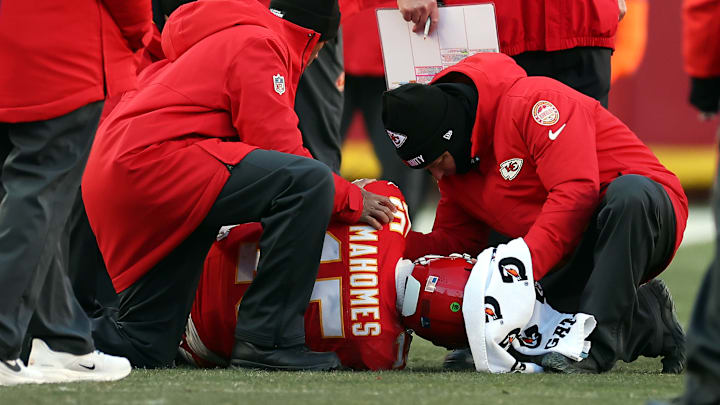
As the Kansas City Chiefs look toward an uncertain offseason, no concern looms larger than how Patrick Mahomes’ knee injury will define the franchise's next year. With reports confirming both an ACL and LCL injury and subsequent surgery, Chiefs fans are doing their best to sift through the updates and understand what to expect.
To help make sense of it all, we spoke with Dr. Ayoosh Pareek, an orthopedic sports medicine surgeon at Hospital for Special Surgery (HSS) in New York and New Jersey and an Assistant Professor of Orthopedic Surgery at Weill Cornell Medicine. Dr. Pareek specializes in complex knee injuries and has worked with professional athletes at the highest level, including serving as a physician for the New York Mets and New York Knicks.
Dr. Pareek recently broke down some key information for us, from the need for a quick surgery for Mahomes to how the quarterback might try to accelerate his rehab.
Mahomes’ procedures involved an ACL/LCL. Can you speak to the difference in potential rehab, knowing as much as we can from the outside, about the LCL information coming out as well?
The rehab depends on a little bit regarding surgeon preference with multiligament injuries, where more than one ligament of the ACL, PCL, MCL, and LCL requires treatment. Practically, whenever more than one ligament is injured, there is typically more protection in the early phase of recovery. This means more bracing and stricter avoidance of putting too much weight on the leg. Some surgeons may not allow any weight on the leg for 4-6 weeks, while others may allow partial weight on the leg. In addition, the range of motion is also typically restricted if two ligaments or more are treated surgically.
For a standard ACL reconstruction, we typically allow weight bearing and unlimited range of motion, but for an additional LCL, most surgeons would limit the early range of motion from 0-90 degrees for a few weeks to ensure adequate healing. These protocols are changing, and some surgeons are allowing earlier weight bearing and earlier range of motion, but the research in this area is evolving. Overall, this whole process lengthens the time to field by 2-4 months, as long as everything goes well, but there are ways to accelerate rehab later in the recovery to make up for the initial restrictions.
You said you can accelerate rehab later. How does that happen?
The ligaments that are repaired or reconstructed need time to heal, and there isn't a great way to speed up biology other than good surgery, appropriate nutrition, rest, and protection. But once the ligaments are healed, most of the recovery is focused on muscular strength, muscular endurance, and neuromuscular control or proprioception, especially in cutting or pivoting activities.
You can focus on rehabilitation activities addressing those components a lot more intensely to minimize the delay for return to sports, which for most athletes is 9-12 months after an ACL injury and likely slightly longer for a knee injury involving two or more ligaments.
What is the literal next step for Mahomes related to the surgery/recovery?
The literal next step is protecting the knee and controlling the swelling. I think about knee rehab in overlapping phases: 1.) Swelling/pain control, 2.) restore range of motion, 3.) normalize walking mechanics, 4.) rebuild strength and control, 5.) return to running, and 6.) progress to cutting/pivoting and sport-specific drills. After his surgery, he will be working a lot on inflammation via ice, anti-inflammatories, and elevation. He will also start range of motion per his surgeon's guidelines, often within 2-3 days after surgery.
The main goal for the first 3-6 weeks is to minimize inflammation and get a good range of motion in the knee because we have a limited time window to obtain that. We can typically obtain strength and agility later on, so rushing into that is not always beneficial.
Were you surprised that Mahomes underwent surgery so quickly? A report from Adam Schefter made quite a big deal about it.
That's not too surprising, but it depends on the injury pattern and imaging. Sometimes, getting to certain injuries within the first 1-3 days can be advantageous because it allows for repairing tissue and improved outcomes if tissue quality is good. Mahomes will have access to excellent rehab. This was a worry a few years ago, and sometimes we do have to wait for decreased swelling and an appropriate range of motion, but earlier surgical management is becoming more and more common, especially in multiligament knees.
 Add us as a preferred source on Google