

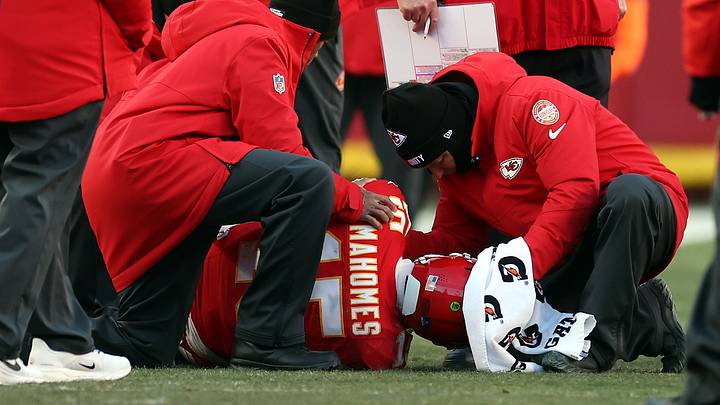
Last season essentially ended for the Chiefs and their fans when Patrick Mahomes tore both his ACL and LCL in his left knee during their Week 15 game against the Chargers. Since then, there has been hope that he could return early in the season, but after head coach Andy Reid announced that Mahomes will "most likely" be playing in Week 1, it appears Chiefs fans' prayers could be answered.
But serious injuries like ACL and LCL tears usually mark a decline in skill position players like running backs or wide receivers—so what about quarterbacks? Better yet, what about quarterbacks in the prime of their careers, like Mahomes on the heels of greatness?
The good (but rare) post-injury seasons
It's not all doom and gloom, at least not yet, because there are definitely a few examples of quarterbacks thriving and not just surviving after tearing their ACL or LCL. And the Chiefs even felt the sting of one of those examples just a few years into Mahomes' tenure as the leader of Kansas City's newfound dynasty.
Joe Burrow, 2021-22
Joe Burrow in 2020 was a rookie coming off the best college football season in modern-day football, possibly in all of NCAA history, but his rookie season saw him sidelined after ten games with a torn ACL as well as a torn MCL in his left knee—the same leg as Mahomes. Also like Mahomes, Burrow returned as quickly as possible just nine months later and led his team past Kansas City on the way to a Super Bowl loss.
Burrow's sophomore season saw him throw for over 4,600 yards and 34 touchdowns with the best completion percentage in the league (70.4%), adding 1,105 yards and five more touchdowns during the four postseason games that eventually ended in heartbreak under the brightest lights against Matthew Stafford and the Rams.
Perhaps the best silver lining of Burrow's season when looking towards Mahomes' 2026 campaign is that the former LSU Tiger achieved all of that success, as well as the Comeback Player of the Year award, while leading the league in sacks taken (51) and sack yards (370). This is definitely a sigh of relief when looking at the offensive line issues KC is already facing before the first whistle of the year.
Tom Brady, 2009-10
Obviously Chiefs fans know about Tom Brady's severe leg injury in 2008, just six months removed from nearly completing the first-ever 19-0 season. That's because it was Kansas City, specifically Bernard Pollard, who tore Brady's ACL in the season opener.
After missing the entirety of the 2008 season, a luxury that Mahomes was not given, the seven-time Super Bowl Champion started and played all 16 games in 2009 on the way to a Wild Card loss against Baltimore. During those 16 regular-season games, Brady threw for just under 4,400 yards (fifth most), 28 touchdowns (fifth most) and had the sixth-best QBR of his career (74.1).
Brady's ACL injury at the hands of KC was miraculously the only one of his long and illustrious career, and it proved that ACL tears do not always halt a quarterback's ascension to Canton, which should be all that Chiefs fans truly care about at this point.
Carson Palmer, 2006-07
Palmer, a Hall of Fame inductee in 2021, had a few really good seasons across 15 years in the league but it was his breakout sophomore season that brought him to the forefront. That 2005-06 season, Palmer led the league in completion percentage (67.8%), passing touchdowns (32), and touchdown percentage (6.3%). That's why it was such a brutal gut punch when Palmer tore both his ACL and MCL just two plays into the Bengals' Wild Card loss in early January of 2006.
Amazingly, with a month less rehab time than Mahomes has had, Palmer was able to start and play all 16 games. He played well enough to earn a Pro Bowl roster spot (back when that meant something) with 4,035 yards through the air (fifth most) and 28 touchdowns (second most).
That season, Palmer nearly dragged yet another mediocre Bengals team to the playoffs almost 11 months removed from the gruesome injury, but three straight losses to end the season edged Cincy out of postseason contention with an 8-8 record.
Still, Palmer showed Chiefs fans that full seasons coming off serious ligament tears are possible and that success is a subjective term that could mean Super Bowl victories to some or Pro Bowl nominations to others. To some, the word "success" could even mean an 8-8 record but a full bill of health at the end of 17 weeks.
Jimmy Garoppolo, 2019-20
This might seem like a stretch, especially since Chiefs fans have seen "Jimmy G" on the biggest stage and exposed his weaknesses for the whole world to see, but it's still worth looking at when preparing for Mahomes' 2026 season.
Garoppolo only started 10 games in five seasons before tearing his ACL against—wouldn't ya know it—the Kansas City Chiefs, just three games into his 2018 season. What particularly stings for Jimmy G is that those three games were the beginning of his first true season as an outright starter in the league. He had just signed a record-setting five-year, $137.5 million contract earlier in the year and suddenly had to rehab his left knee instead of playing for the touted 49ers offense.
But, much to the chagrin of haters and NFC West rivals, Garoppolo returned in 2019 and played the best year of his 12-year career. He went 13-3 and thoroughly thumped the Vikings (27-10) and Packers (37-20) on the way to the Super Bowl, where Mahomes would eventually secure his first of three Lombardi trophies.
On the road to that Super Bowl, Garoppolo led the league in fourth-quarter comebacks (four) and had career highs in passing yards (3,978), touchdowns (27), and game-winning drives (four). The downside to this story is the rest of his career, which only saw him play one more complete season across six years and three separate teams.
The usual, not-so-great returns to the field
Ryan Tannehill, 2018-19
Tannehill was never truly a great quarterback, even in his prime, but a gruesome hit by Calais Campbell in December of 2016 was the beginning of a long history of injuries for the former Texas A&M superstar. To make matters worse, just nine months later, he would reinjure the left knee during a 7-on-7 drill in training camp, which inevitably killed his entire 2017 return season.
So technically Mahomes already has a leg up on Tannehill (no pun intended), but where he doesn't is the injury itself: Tannehill only had a "slight ACL tear" and a Grade 2 MCL sprain. I'd say that levels the playing field in a way, but what also gives Mahomes the upper hand is the much better supporting cast than the Dolphins gave Tannehill when he finally returned in 2018.
That was the season that saw Adam Gase "coaching up" guys like 35-year-old Frank Gore, 33-year-old Danny Amendola, and Mahomes' old buddy Albert Wilson when he was just joining Miami. The Dolphins would end up 7-9 that season (5-6 with Tannehill under center), with the sixth-worst offense and the fifth-worst defense when it was all said and done.
With all that laid out, it's important to note that Tannehill also turned 30 during his return season—just like Mahomes—and he only finished 11 games in 2018 due to a shoulder injury caused by a hard hit from (yet another Chief) Carlos Dunlap when he was with Cincinnati. During those 11 games, Tannehill put up less than 2,000 yards in the air and only 17 touchdowns, ultimately marking the end of his tenure in Miami before a resurgence in Tennessee under Mike Vrabel.
Carson Wentz, 2018-19
The Carson Wentz experience in 2017 was truly one to behold, especially with the MVP race heating up between the Eagles' breakout quarterback, Tom Brady, and Todd Gurley. Sadly, as many remember, that MVP season was cut short 13 weeks into the season on a scramble into the end zone against Gurley and the Rams in early December.
Just like Mahomes, Wentz tore his ACL and his LCL in his left knee, but Wentz really felt the fire as an MRI also showed meniscus damage and a partially torn IT band. And, just like Mahomes, the surgery was on the schedule ASAP within 72 hours of the injury. What's different between these two QBs (who were actually teammates just two seasons ago) is that Wentz was not able to return in Week 1 the next year despite the same recovery time, eventually showing back up in an Eagles uniform for a Week 3 matchup against the Colts.
That gnarly leg injury has been deemed the destroyer of Wentz's promising career, taking much more than just the MVP trophy away from him. It was obvious during that return season in 2018 that Wentz was not truly the same player, going 5-6 in 11 games before a back injury took him back to the sidelines late in the season.
Wentz put up some respectable numbers during those 11 games though, throwing for 3,074 yards and 21 TDs, which gave him a career-high 279.5 passing yards per game. But the damage was done and the message was written plain as day, especially after Wentz's backup Nick Foles quickly became the darling of every NFL fan's doting eyes by beating Brady in Super Bowl LII.
Since the ligament damage in 2017, Wentz has played two full seasons (one in Philly and one in Indianapolis) but has only made the playoffs once, losing in the 2019 Wild Card game vs Seattle. He has played for five separate teams in the past six seasons and only recently beat out possible-bust J.J. McCarthy for QB2 in Minnesota this past week.
Kyler Murray, 2023-24
The former Heisman winner was a breath of fresh air for Cardinals fans when he first arrived in 2019 with the first overall pick, but after three straight middle-of-the-road seasons, the taste was beginning to sour. Then came the ACL tear in mid-December of 2022 as the team was 3-8 and already looking toward the 2023 Draft.
Despite their injuries almost occurring on the same day four years apart, there are a few differences between Murray and Mahomes' ligament tears. One is that Murray's ACL tear came from a non-contact play while Mahomes was tackled from behind by Los Angeles Charger Da'Shawn Hand. Murray also waited weeks before surgery, which could be one of the many reasons why he could not return to play until Week 10 of the 2023 season.
Murray may have wished he had waited longer, though, especially considering he went 3-5 in the eight games he played during his return year, with fewer than 1,800 yards through the air and only 10 passing touchdowns. But, as many know, Murray is known more for his speed and running abilities which still dropped drastically from the pre-injury player he was.
In the 3.5 seasons he played before the injury, he averaged 38.6 rush yards per game, with his sophomore season (51.2 ypg) shining high above the average. He also averaged nearly six rushing touchdowns a season, 5.75 to be exact, with that sophomore season (11 rushing TDs) truly outperforming the other three years. Since returning in Week 10 of 2023, Murray has averaged under 33 rush yards per game and only scored nine touchdowns on the ground.
Obviously Murray and Mahomes' game plans, offensive-minded coaches, support systems, and playing styles are different, but with the way Mahomes has learned to run away from pressure and create something out of nothing like Murray does well, it's worth noting they could be more alike than we believe.
Robert Griffin III, 2013-14
Most NFL fans cringe when they think of Robert Griffin's terrible, gruesome leg injury in the Wild Card round of the 2013 playoffs. It was amplified by the poor handling of a previous LCL injury in his right knee earlier in the season, something he and the coaching staff believed he could play through before they realized they were dead wrong.
The collapse on the field over a low snap came in the pivotal fourth quarter of a playoff game that Washington fans were desperate for after years and years of disappointment and shame from poor ownership all the way down to horrendous coaching. Griffin III, or "RG3" as many know him, tore his ACL and LCL on January 6—nearly a month after Mahomes (December 14)—yet he rushed back to the field for a Week 1 matchup against Philadelphia nearly eight months later.
The season was one from Hell, ending with just 13 games played by RG3, who could only lead them to a 3-10 season before being benched to preserve his health (and show Washington what Kirk Cousins could be). During those 13 games, he actually passed for three more yards (3,203) than he did in 15 games his rookie year (3,200), but it was obvious he was not the same QB who won Rookie of the Year one season earlier.
Griffin's return year was marred by endless conversations of rushing him back on the field too fast, but it showed the most when he would attempt to scramble or rush on a designed QB run play. His rookie season saw 815 rush yards (fifth-most by a QB in NFL history at the time) and seven TDs. His return-from-injury season saw only 489 yards and a big, fat zero on the touchdown stat sheet at the end of the year.
He was never the same after the injury and he has been vocal about players recovering and healing longer than coaches or trainers may want you to, especially when it comes to ACL and LCL tears. Luckily for Mahomes, he has been paid enough to feed his grandchildren's grandchildren, so if his career were to tank like RG3's did, at least he is set up for success ... the same cannot be said about Griffin III as he was quickly shoved from backup roles in Cleveland to backup roles in Baltimore, all with serious injuries and concussions before retiring in 2020.
All in all, Mahomes has a tenacity and killer instinct that almost all of these quarterbacks simply didn't or don't have, which could be the thing that propels Mahomes up to the levels of Brady and Burrow in their return years. But that ferocity that he has become known for could also be the leading step to a downfall that has taken the promising careers of so many quarterbacks with amazing skill sets.
The true test will be how he does against the Denver Broncos' stout pass rush on Monday night to open the season.
 Add us as a preferred source on Google