

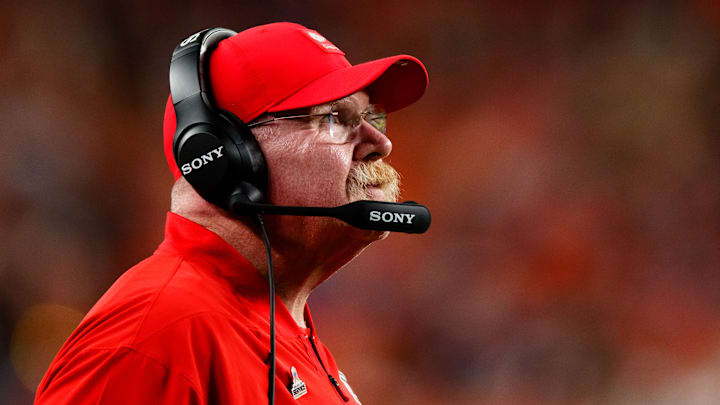
From their parking lot tailgates to their parents’ basements, NFL fans nationwide are rejoicing in the Kansas City Chiefs’ apparent demise. The pursuit of the three-peat is over, and the good fortune that seemed to follow this team from game to game appears to have subsided.
Internally, it is particularly puzzling for Kansas City fans because when the season began, it truly felt like this was the most talented Chiefs roster in years. Theories continue to circulate on the airwaves and social media as to how we got here, but beyond just the 2025 team, the question can now be asked: Is the dynasty really over? What is a dynasty?
The unwritten rule about an NFL dynasty is three Super Bowl wins within five years. The Chiefs achieved that by beating the 49ers, Eagles, and 49ers again within a five-year span during the 2019–2023 seasons. This is a legacy that can never be taken away, and the proud franchise still boasts key pieces who guided them to each of these victories in Andy Reid, Brett Veach, Steve Spagnuolo, Patrick Mahomes, Travis Kelce, Chris Jones, and Harrison Butker, among others.
Everyone wants to close the book on the Kansas City Chiefs dynasty, but is it really over?
However, there isn’t really a code for what ends a dynasty. Perhaps a look back at teams who have achieved dynasty status, and evaluating how those dynasties ended, could possibly explain more.
Pittsburgh Steelers
The Steelers of the 1970s won an impressive four Super Bowls in a six-year span. Head coach Chuck Noll had taken over a team that had been literally terrible in the 1960s, and in his first season the Steelers earned the first overall pick in the 1970 draft. With it, they selected quarterback Terry Bradshaw. Noll and Bradshaw directed the Steelers out of the cellar of the AFC Central to third place, then in the next season to second place, and then finally a division championship in 1972. In 1974, the Steelers landed one of the NFL’s all-time great draft classes: WR Lynn Swann (1st round), LB Jack Lambert (2nd round), WR John Stallworth (4th round), and center Mike Webster (5th round) each eventually earned the honor of receiving a yellow jacket ceremony at the NFL Hall of Fame. That marvelous rookie class helped guide the Steelers to their first Lombardi Trophy in Super Bowl IX.
When people think of the Steelers’ dynasty, those four Super Bowls are the bookends of the historical time frame. But long after their win in Super Bowl XIV in January of 1980, Noll was still going back to work with Bradshaw, Franco Harris, Stallworth, Webster, Joe Greene, Lambert, Jack Ham, and Mel Blount. Thus, the question must be asked: Is the dynasty still intact if the key pieces are still there? To be sure, the Steelers missed the playoffs entirely in 1980 and 1981, but they at least went 8–8 and 9–7 in those years and were scrapping for a playoff spot.
In Bradshaw’s final season, the 1982 Steelers returned to the postseason, only to lose in the wild-card round. By then, Greene, Swann, and Ham had retired. Harris retired a year later. Though Mark Malone guided Pittsburgh to the conference championship game in 1984, the Steelers came up short, and after that, Noll could only muster them to the playoffs once in his final seven seasons as head coach. Pittsburgh boasted so many legendary players on both sides of the ball, but when you mention their dynasty, Noll and Bradshaw are the two who immediately come to mind.
San Francisco 49ers
Joe Montana and the 49ers won four Super Bowls from 1981 to 1989. But they did not have three of them within a five-year span. So why are they commonly referred to as a dynasty? They had the head coach in Bill Walsh for the first three Super Bowls. They had the quarterback. They had the star receiver in Jerry Rice, a record-setting Hall of Famer who, to this day, is widely regarded as the greatest wide receiver in NFL history. The 49ers also had remarkable consistency, reaching the postseason in 16 out of 18 seasons between 1981 and 1998.
Drafted out of Notre Dame in the 3rd round of the 1979 NFL Draft, Montana sat for almost the entirety of his first two seasons before becoming the starter in 1981. He immediately became a star, guiding San Francisco to a 13–3 record en route to a Super Bowl victory in his very first season as a starter. Rice wasn’t drafted until after the first Super Bowl win, and Walsh wasn’t there for the last one, but Montana was the constant.
Upon Walsh’s retirement after winning Super Bowl XXIII, longtime defensive assistant George Seifert took over as head coach. In his first season as an NFL head coach, Seifert guided the 49ers to the second of the team’s back-to-back championships with a resounding 55–10 win over John Elway and the Denver Broncos. Montana departed a couple of years later, and Seifert earned a second ring of his own with Steve Young at the helm. The team maintained remarkable consistency throughout that span, perennially making it to the divisional round and playing in 10 NFC Championship Games in 17 years.
Though that 1994 team still featured Rice at wide receiver, the roster from the 1980s Walsh teams had by and large been turned over. So, generally speaking, when people refer to “the 49ers dynasty,” they are talking about the Walsh era of the 1980s. If there were a Mt. Rushmore of the San Francisco 49ers’ dynasty, it would include Montana, Walsh, Rice, and safety Ronnie Lott.
Dallas Cowboys
The Cowboys’ dynasty of the 1990s was perhaps the cookie-cutter model of how a team ascends to greatness. Jimmy Johnson took over the once-proud franchise that had been mired in mediocrity for most of the 1980s. Johnson guided the team quickly through the selection of quarterback Troy Aikman and then a midseason trade that would change the landscape of the NFL forever.
On Oct. 12, 1989, with the team mired at 0–5 and Aikman already injured, Dallas shipped star running back Herschel Walker to the Minnesota Vikings in exchange for five players and six draft picks. Johnson would whirl and twirl those picks into other trades that laid the foundation of a champion. The Cowboys selected NFL all-time leading rusher Emmitt Smith in 1990, and the “Big Three” was set. Aikman, Smith, and wide receiver Michael Irvin combined to become one of the NFL’s most feared trios in league history. The Cowboys won two consecutive Super Bowls in 1992 and 1993, and were talking about a three-peat with new head coach Barry Switzer before getting throttled on the road against Young and the 49ers in the NFC Championship Game.
The dynasty was cemented in 1995 when the Cowboys cruised to a 12–4 record before smashing all three of their playoff opponents by double digits. Remembering the trade that built the team, there were so many ancillary parts who were key contributors during Dallas’ run. Russell Maryland, Darren Woodson, Jay Novacek, and others would also bask in the glory, but the legacy of the Cowboys’ dynasty rests easily on the shoulders of Johnson, Aikman, Irvin, and Smith.
New England Patriots
The Patriots are a fascinating case study here because the team achieved the standard of “three Super Bowls within five years” twice: the first from 2001–2004 and then three more from 2014–2018. So here is the million-dollar question: Does a nine-season drought in which a team won zero Super Bowls mean the dynasty was over?
The upstart Patriots shocked the world when they upset the “Greatest Show on Turf” St. Louis Rams in Super Bowl XXXVI. Tom Brady became an instant media darling with the famous shot of him celebrating with his hands over his head, visibly shocked at what his team had just done. It wasn’t so cute in 2003 when the team went 14–2 and won the Super Bowl again, or in 2004 when they went 14–2 again and won a third ring in four years.
With the dynasty intact, the Patriots maintained a constant, steady presence in the AFC playoff field every year. Brady’s elevation from 6th-round quarterback to annual All-Pro remains one of the biggest NFL surprises of all time. Bill Belichick’s swarming defenses continually kept the Patriots in every game. But something unique happened:
Over the next nine seasons, Brady, Belichick, and the Patriots went to five conference championship games and two Super Bowls, but could not win a ring. It wasn’t until January of 2015—ten years after their last Lombardi Trophy—that New England climbed the NFL’s ultimate summit by defeating the Seattle Seahawks. At that point, the entire roster had turned over, and the only remaining pieces were literally Brady and Belichick, as well as coaches deserving mention—Josh McDaniels and Brian Daboll (both of whom had left for other jobs and then returned to New England), Matt Patricia, and Brian Flores.
If not for a failed two-point conversion at the end of the 2015 AFC Championship Game, the Patriots would have attended five consecutive Super Bowls from 2014–2018. Winners of three, Brady, Belichick, and the new generation of Patriots had once again sealed their names into league history books.
Each of the two sections of the Patriots’ legacy looked similar: Rock-solid, dependable quarterback play combined with top-echelon defense makes a team look pretty good. And though the names and faces around the QB/Coach combo were different, time has a funny way of melding the two sections of time into one impressively consistent and dominant force in the league.
The fact is, as time goes on, the more and more we will gaze back upon 20 years of the Patriots and consider them one singular dynasty.
Reflecting on this list, from Pittsburgh to San Francisco, from Dallas to New England, there is a definitive pattern. It is the combination of Super Bowl wins by a quarterback and the head coach that determines the bookends of a dynasty. Bradshaw and Noll. Montana and Walsh. Aikman and Johnson. Brady and Belichick.
And that is where we get the answer to our question of “What is a dynasty, and when does it end?” Keep in mind, the dynasty is a subjective achievement, one that is not rewarded with any trophy or annual ceremony. A dynasty is a talking point, and the New England Patriots are an example of a team whose dynasty lasted longer than teams of the past. In spite of the Super Bowl drought they experienced in the middle of their reign, no one will look back on that time and say that the Patriots weren’t a contender.
And now the Kansas City Chiefs, three-time Super Bowl winners with Patrick Mahomes and Andy Reid, find themselves at an apparent crossroads. Haters want to jump the gun, of course. “It’s over!” they shout from their mothers’ basements. Of course they do. They say it’s over because they desperately want it to be over. After Sunday night’s loss to the Texans, haters were lined up out the door to deliver what they hope is prophetic truth. They have all forgotten one very important variable in every dynasty’s framework: Though the roster and even parts of the coaching staff may change, history tells us that the quarterback/head coach combo is the glue that holds true dynasties together. And that it’s mostly about the guy under center.
This leads us to the conclusion that the dynasty will not end until the team is done winning Super Bowls with Patrick Mahomes at quarterback.
Reid and Mahomes make just the third combination of head coach and quarterback to win three Super Bowls together. That’s rarified air, and though the team’s playoff chances in 2025 have rapidly dwindled to absolute life support by early December, anyone who tries to claim that “the dynasty is over” simply can’t see the forest for the trees. Mahomes is still just 30 years old, and Reid has given zero inclination to make anyone think he won’t be back in 2026.
Moreover, Reid’s presence won’t end the possibility of a dynasty, as evidenced by the 49ers’ and Cowboys’ wins with new head coaches. The team might go two years, three years, or even ten years like the Patriots did, but even if the Chiefs win just one more Super Bowl, history will still say it was part of the dynasty. At the end of the day, it’s all about the quarterback, and as long as Patrick Mahomes is taking snaps as the Chiefs’ quarterback, the dynasty is alive and well.
 Add us as a preferred source on Google