

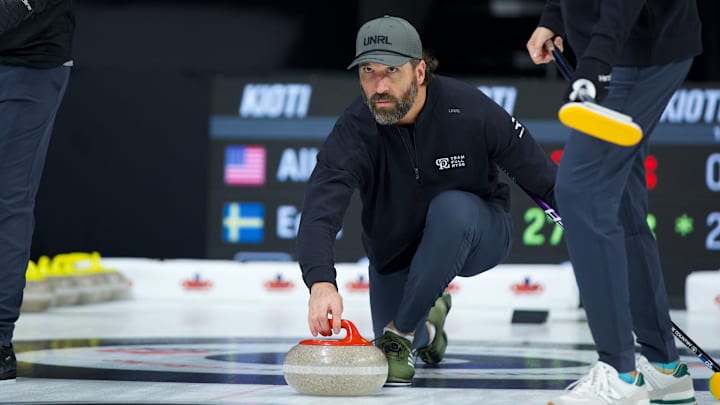
Betting against Jared Allen is a foolish decision.
In the years since his retirement, Allen has built a second act every bit as surprising—and committed—as his first. What started as a friendly bet has turned into a full-blown Olympic pursuit in curling, fueled by the same obsessive work ethic that made him a Hall of Fame pass rusher. And while his competitive drive hasn’t faded, Allen says life after football has been marked more by contentment than by searching.
We recently caught up with the former Chiefs and Minnesota Vikings star to talk about his unlikely curling journey, why retirement never left a void, and what his relationship is like with the Chiefs organization today.
An in-depth conversation with Jared Allen about his unlikely Olympic pursuit, life after football, and his renewed connection to Kansas City.
Matt Conner: Let’s talk about curling. This whole pursuit started with a bet, right? What exactly was the bet—and were other sports on the table?
Jared Allen: The bet was simple. I had a golf bet with a buddy a few years after retirement to try to make a PGA Tour event. We were at the house, he had more drinks than I did, and I said, “We should reduce the bet because you can’t afford it anyway.” Then I said, “I’ll bet you whatever I can make the Olympics.” And that was that.
So I started looking at what we’re really bad at. We’d never medaled in badminton. We had one bronze in curling. I thought I could do badminton. I wanted an individual sport. I even considered clay shooting, but that field was packed. My wife suggested I find a buddy to do something with. When we moved to Nashville, I talked to Boulder about trying to make the Olympics in badminton. He watched the videos and said we’d probably hurt ourselves.
So we chose curling. We were watching the 2018 Olympics. Schuster goes on this amazing run and wins gold, and then it gets out that I'm trying to make the Olympics in curling—so I looked like a jerk. But I was already down the rabbit hole with coaches and teammates, so I continued. Over time, teams changed, life happens, but I ended up playing with Jason Smith consistently. I fell in love with the sport. I go all in.
Is that your personality in every lane of life?
I have a theory: if you’re going to learn something, learn it from the best. More people should probably take that approach. When we first started, John Benton offered to coach us. He’d fly out to Nashville and taught us the fundamentals. Then I worked a lot with Dave Jensen, Pete Annis—great coaches. The curling world is small, so you’re always picking brains.
And it’s the same with anything physical. I can pick movements up easily. It’s the nuances you want to learn from the best. Through football and through life, I’m always trying to be a student. I want to be humble enough to learn. If I'm going to do something competitively, I put in the time. I’m not going to go out there and suck. Not for my ego, but out of respect for the game.
When you describe curling or some of these pursuits, it makes me wonder—was there a void after football?
No, not at all. I was completely content in retirement. Curling and everything else actually take away from my joy of doing nothing.
It just happened to be a bet. I'm one of those rare guys who was perfectly content with my career. Football is such a small microcosm of the rest of your life. I never found my identity in football. My identity has always been first in Christ. As I got married and had kids, being a husband and father became more important.
I was ready to retire after year 10. Cris Carter gave me advice: when you think you’re done, play two more. I did. I knew going into my last season that the Super Bowl was my last game. I never got cut. Every time I was traded, I asked for it. That’s a blessing. And when I realized I didn’t want to put six hours in the gym anymore, that was the sign. It wasn’t about the games—it was about the grind from Monday to Saturday.
That’s rare. Most former players talk about an identity crisis.
A lot of factors go into it. The average career is three years—people aren’t walking away after three years on their own terms. Some guys get hurt, or feel they didn’t achieve what they wanted. Some don’t have the finances. Some are trying to fill a limelight void.
I was lucky. I was raised with strong role models—my grandfather and father were my heroes. Not everyone has that. And I always set myself up for the end. By year 12, I knew exactly who I was. I’d hit the goals I wanted. I wasn’t chasing money or stats anymore. Carolina asked me to come back, but my kids were getting older, and we wanted to be young parents. Football was over, and I was good.
How intensely do you follow the NFL today?
I didn’t for a while, but now I check scores so I’m not an idiot in conversations. I’ve got buddies who are GMs and coaches. I check on their teams, check the Vikings. I can’t remember the last time I watched a full game. I don’t have three hours to sit there.
What’s your relationship with the Chiefs today?
Oh yeah, those bridges have been mended. I’ve been back several times. They were very present at the Hall of Fame ceremony. My two teams are Kansas City and Minnesota. I retired as a Viking, but I have a lot of love for the Chiefs organization and community. I never wanted to leave. Circumstances were what they were. But they drafted me. They let me accomplish my childhood dream. Those ties matter.
Last one: Who is a player or coach you feel never got the respect or spotlight he deserved?
There are a few. John Browning. Amazing defensive tackle I played with in Kansas City. Fantastic three-technique. He could bend, he had a skewed back, he taught me a ton.
Kevin Williams got accolades when he played, but he’s not getting his kudos now. He should’ve already been a Hall of Fame finalist. Him and Luke Kuechly are the only two five-time All-Pros not in the Hall.
Coaches—position coaches hardly ever get recognition. Bob Karmelowicz, Tim Krumrie, Carl Dunbar—fantastic coaches. Brendan Daly is doing great things in Kansas City. Brian Silverfield is killing it as the Memphis head coach. There’s a long list.
And role players too—Jimmy Kleinsasser, for example. Tight end position changed, but Jimmy was a monster. If he put his hands on you, it felt like a guard was hitting you. Tons of guys like that.
 Add us as a preferred source on Google