

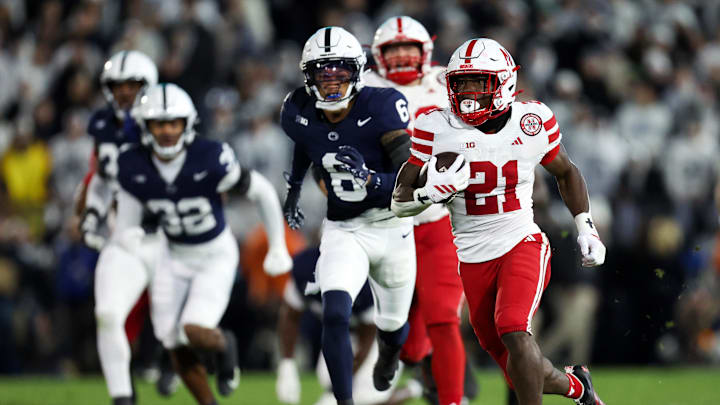
The backfield reinvention was mostly set coming into the 2026 NFL Draft, but in the fifth round, Nebraska running back Emmett Johnson was just too enticing. In fact, general manager Brett Veach traded up for him. For some people, Johnson was the fourth-best player in the 2026 running back class. That could create excellent draft value for the Chiefs with this selection.
Kenneth Walker III was brought in via a major free-agent signing. He will undoubtedly be given the starting workload. But in reality, you could already argue that Johnson steps in as the potential RB2 for K.C. immediately as a rookie.
With Johnson's diverse skill set being paired with the well-established Walker, it's easy to see why the Chiefs liked this draft prospect. Here are three key areas in which Johnson elevates the Kansas City backfield.
Johnson has real pass-catching upside
In his last two years at Nebraska, Johnson tallied 656 receiving yards and averaged 7.7 yards per catch. It can be hit or miss whether incoming rookie running backs have upside to be a threat on passing downs. Johnson checks that box exceptionally well.
He was pinpoint with his route running out of the backfield. Johnson sets up plenty of breathing room for a throwing window. This shows up on both swing routes toward the perimeter and screen passes in the middle of the field. The Nebraska product also did a fine job of selling routes and being patient. He would look to act as a blocker before delaying out of the backfield. Johnson creates comfort as a security blanket underneath due to that factor.
Ideally, his mix of vision and feel for space opening up allows Johnson to create adequate yards after the catch as a pass-catching running back. If you look at the history of the screen game and swing game in Andy Reid's offense, Johnson is a tremendous fit for it.
Explosive plays are waiting to happen
Johnson registered over 1,800 yards last season for the Cornhuskers. He was the only FBS player to average 150+ scrimmage yards per game in 2025, via Chiefs team reporter Matt McMullen. Much of his production is due to routine chunk gains and explosive plays generated.
It's been well-documented how poor Kansas City running backs were at generating explosive plays the last two years. Walker's addition was a key part in hoping to turn that around. The Chiefs being heavily interested in Johnson as part of that production reversal also makes a lot of sense. Johnson's key is that he can add explosives in multiple ways.
He is able to work and squeeze through tight areas to break free from defenders in the middle of the field. When out in space, Johnson finished among the best in missed tackles forced. Historically, that category is beneficial in determining how well a drafted running back can produce. And as mentioned above, his pass-catching attributes and nimble change-of-direction skills present plenty of yards-after-catch opportunities.
Inside-outside run versatility
The Chiefs appear to be leaning toward more of a downhill running game. With Walker, the Chiefs do not have to rely on as many RPO looks from the shotgun. Patrick Mahomes' recovery also raises the possibility of more under-center action. Plainly put, Kansas City just performed much better when running under center last year, despite the minimal times they did so.
With perhaps a greater emphasis on working downhill, Johnson can mirror the style the Chiefs are hoping to incorporate with Walker. Johnson saw plenty of runs between the tackles. His excellent vision and agile cuts present opportunities to bounce it outside as well. Walker and Johnson bring more steam and juice when working toward the perimeter than what K.C. utilized with recent running backs on outside carries.
Johnson's comfort while running both between the tackles and into space should give the Chiefs more confidence when giving Walker a breather.
 Add us as a preferred source on Google