

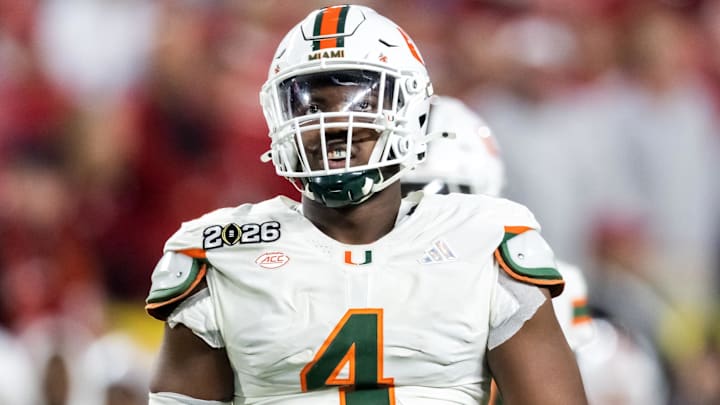
The Kansas City Chiefs currently hold the 9th and 29th overall selections in the 2026 NFL Draft after trading All-Pro cornerback Trent McDuffie to the Los Angeles Rams, and the pressure on general manager Brett Veach has never been higher. If the Chiefs are serious about reestablishing themselves as a true Super Bowl threat in 2026, they cannot afford to leave the first round without adding an impactful player to the defense.
That reality raises the standard for the ninth overall pick. This is not the range of the draft where teams should be satisfied with a solid starter, a high effort contributor, or a player whose value is rooted primarily in the intangibles (shameless plug: listen to my Arrowhead Addict podcast). The top 10 selections are supposed to alter the equation. They are supposed to buy players who force offenses to change protection plans, speed up their timing, and live in fear of long-yardage situations. At edge defender, that means investing in a player whose profile suggests not just competence, but the realistic potential to develop into a consistent high-end pass rusher.
And that is where the Rueben Bain Jr. conversation becomes uncomfortable. Once the hype is stripped away and his profile is examined more critically, the debate centers on a historically rare physical outlier at one of the league’s most projection-sensitive positions. More specifically, it centers on a pass-rush archetype that has produced virtually no evidence of star-level NFL sack production over the past decade. For a team drafting ninth overall, that is not a minor concern. It's the concern.
The measurement that changes the Bain conversation
Rueben Bain's arm length is no longer a rumor or a “we’ll see at Indy” storyline. It’s official.
Per the NFL Combine, Bain’s 30 7/8-inch arms are not merely short for an edge defender. They are historically short for a player being discussed in the top 10. Pro Football Network noted that his measurement ranks as the fourth-shortest among edge rushers since 1999. If Kansas City were to select him at No. 9, they would not simply be betting on a slightly unconventional prospect profile. They would be investing premium draft capital in an outlier among outliers.
That distinction matters because the sub-31-inch arm-length bucket is not small by accident. Among the 442 defensive linemen drafted over the past decade, only six entered the league with arms under 31 inches. On the surface, that is a tiny sample, and small samples always require caution. However, scarcity does not automatically make a set of data meaningless. In many cases, scarcity is itself evidence of escalating selection pressure, meaning that as the level of competition rises, certain traits become more difficult to overcome and the player pool is gradually filtered toward attributes that scale more reliably against stronger opposition.
A useful comparison would be a 5-foot-6 wide receiver. Imagine there are 500 nationally ranked high school receivers at that height who are talented enough to receive a Division 1 scholarship. Of those 500, only 10 play well enough in college to be drafted, and only one goes on to produce a 500-yard NFL season. That does not mean a 5-foot-6 receiver cannot succeed. It means the pathway becomes increasingly restrictive as the competition improves, and the advantages associated with greater size begin to outweigh the compensatory traits required from smaller players.
The same logic applies here. A sub-31-inch arm-length profile does not make NFL success impossible, but it does suggest that the league’s developmental pipeline has been applying selection pressure against that build for years. And this is where credibility weighting (or Bayesian inference) becomes relevant.
In simple terms, credibility weighting is the process of deciding how much confidence to place in a result based on the strength and reliability of the evidence behind it. Bayesian inference works similarly by starting with a prior expectation and then updating that belief as new evidence becomes available. In this case, the sample of comparable players is small, so it should not be treated as absolute proof. But it also should not be ignored. The rarity of successful outcomes in this archetype is still a meaningful prior, and it suggests the Chiefs should be extremely cautious about treating a rare exception as the expected outcome.
Betting on this type of profile is not a bet the Chiefs should be making with a top-10 pick.
The comparison most often used to calm concerns is not nearly as reassuring as it sounds
When evaluators attempt to minimize the concern, the name that surfaces most often is Calijah Kancey. On the surface, that makes sense. If the goal is to find a recent example of a defensive lineman with unusually short arms who wins with first-step explosiveness, hand violence, and compact power, Kancey is the cleanest modern comparison. Pro Football Network even identified him as Bain’s closest physical analogue, noting that Kancey measured in with 30 5/8-inch arms before being selected 19th overall in 2023.
The problem, at least from Kansas City’s perspective at No. 9, is that Kancey does not meaningfully weaken the broader concern. If anything, he reinforces it. There is no evidence that this body type consistently translates into high-level NFL sack production. He is evidence that the absolute best-case outcome for this archetype still appears to exist on a very narrow developmental path.
That distinction matters. Of the six defensive linemen drafted over the past decade with sub-31-inch arms, Kancey is the only one to record even a single NFL sack. Yes, the sample is small, and any honest analysis should acknowledge that, but this is where credibility weighting and Bayesian reasoning become useful. A limited sample should not be treated as conclusive proof, but neither should it be dismissed when the signal is this lopsided. The prior evidence still points in the same direction: this is not an archetype that has consistently scaled into reliable NFL pass-rush production.
It also fits the logic of escalating selection pressure. As competition intensifies, traits that can be managed at lower levels become harder to overcome against NFL size, length, and technical refinement. So while Kancey may represent the exception, he does not erase the rule. He simply illustrates how rare it is for this profile to survive the league’s filtering process and emerge as productive.
If the Chiefs use the ninth overall pick on Rueben Bain Jr., they would not merely be drafting a talented player with an unconventional measurement profile. They would be making a premium investment in the least stable outcome within an already rare bucket. At that point, they are no longer betting on the norm. They are betting that Bain becomes the exception to a trend the league has been reinforcing for years.
“But Bain was productive in college” is not the argument many people think it is
Bain can play. No serious evaluator is disputing that. The NFL's official site described him as “an explosive, sack-generating machine,” even while acknowledging his suboptimal length. CBS Sports also highlighted the appeal of his tape: power at the point of attack, the ability to generate inside access, effective counters off that power, and legitimate pressure production, including an impressive postseason stretch.
That is all real. It is also not the central question Kansas City should be asking at No. 9 overall.
College production is the entry point, not the conclusion. The real question is whether the underlying traits that produced that success will continue to scale once the environment becomes more demanding. A pass rusher may dominate in college because he is stronger, quicker, or more technically refined than most of the linemen he faces. In the NFL, however, the margin for error shrinks dramatically.
That jump matters. NFL tackles are deeper into their pass sets, their hand usage is more disciplined and more violent, their arms are longer, their anchor is stronger, pocket angles close faster, and Quarterbacks are better at stepping up, resetting, and punishing rushers who arrive a half-second late. In that environment, length stops being an aesthetic preference and starts functioning as a potential ceiling constraint. It becomes harder to create first contact, harder to keep blockers off your frame, and harder to consistently finish rushes once the physical advantages you previously had are no longer there.
This is also where credibility weighting, or Bayesian inference, sharpens the discussion. Bain’s college production is meaningful evidence, but it should not automatically override the prior concern attached to a profile with historically rare length limitations. In other words, the tape should move the evaluation, but it should not erase the risk.
Bain can absolutely win NFL reps. The more important question is whether he can win enough of them, cleanly enough, and consistently enough to justify the expectations attached to the ninth overall pick. Because if he ultimately becomes more of a disruption player than a true finisher, Kansas City will not have drafted a bad defender. They will have drafted a good defender at the price of a star.
What Kansas City should actually be buying at No. 9
If the Chiefs are selecting a pass rusher at No. 9 overall, they should be investing in a profile whose median outcome is worthy of that slot. That is the standard for a premium pick. The goal is not simply to identify a player who can succeed, but to identify one whose most likely range of outcomes justifies the cost of the selection.
That is what makes the Bain conversation so uncomfortable. The argument in his favor too often depends on a chain of rationalizations rather than a clean projection. Ignore the measurement. Assume he will be the exception. Trust that what did not matter in college will not matter in the NFL. Bet on violence, effort, and production overcoming a trait the league has historically filtered against. That is not typically how teams describe a clean top-10 edge profile. It is how they talk themselves into a talented outlier once the price becomes easier to justify.
Bain’s tape, motor, and college production are meaningful pieces of evidence. But the historical record tied to his physical profile still functions as an important prior. Through a Bayesian lens, the goal is not to ignore the positive evidence. It is to update the evaluation responsibly without pretending the preexisting risk was never there.
Bain might become a good NFL player. He might even become a difficult player to block on a snap-to-snap basis. But if Kansas City drafts him ninth overall, it would not simply be drafting Rueben Bain Jr. It would be drafting a historically rare outlier profile and asking it to deliver returns consistent with a prototype. That is the kind of bet teams make when they are chasing an exception instead of buying probability. Kansas City cannot afford to do that at pick 9.
 Add us as a preferred source on Google