

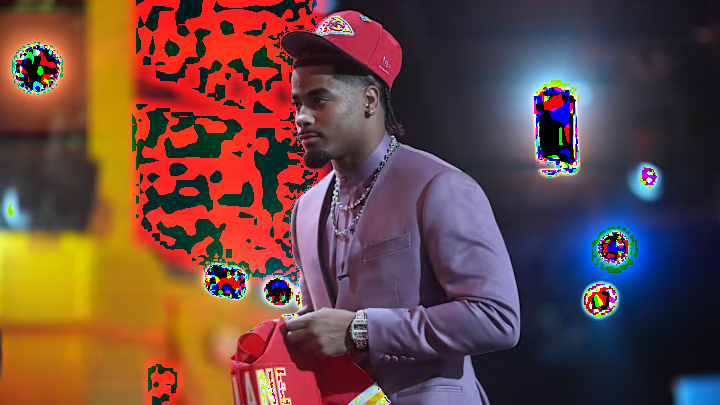
On Thursday night, the Kansas City Chiefs made a bold move, trading picks 9, 74, and 148 to the Cleveland Browns in exchange for the sixth pick. With that selection, they drafted LSU cornerback Mansoor Delane, and the initial fan reaction wasn't thrilled. The frustration centered on the idea that the Chiefs have "printed cornerbacks" at the mid-to-late stages of the draft in recent years and should've used their top pick on a defensive end instead. The million-dollar question is whether or not that recollection of their draft track record at cornerback is accurate.
To be clear, I have no qualms with the suggestion that edge was a priority for Kansas City's defense coming into the draft. The Chiefs ranked 25th in sacks and 17th in pressures in 2025. We can debate which prospect was most deserving of the pick at six (or nine), but that's not as compelling a talking point for me. My interest here is whether the actual draft history at cornerback aligns with fan recollection.
Here's every cornerback or hybrid (DB/S) pick the Chiefs have made since Brett Veach became general manager:
- 2026: Mansoor Delane (Round 1, Pick 6)
- 2025: Nohl Williams (Round 3, Pick 85)
- 2024: Kamal Hadden (Round 6, Pick 211)
- 2023: Chamarri Conner (Round 4, Pick 119), Nic Jones (Round 7, Pick 250)
- 2022: Trent McDuffie (Round 1, Pick 21), Joshua Williams (Round 4, Pick 135), Jaylen Watson (Round 7, Pick 243), Nazeeh Johnson (Round 7, Pick 259);
- 2020: L'Jarius Sneed (Round 4, Pick 138), Thakarius “BoPete” Keyes (Round 7, Pick 237).
When I look at this list, the hit rate is solid, but not the mythological version fans are appealing to. Trent McDuffie, Jaylen Watson, and L'Jarius Sneed are hits as impact starters. It's still early in the evaluation process for Nohl Williams, but since he's been tabbed for a larger role in 2026, I'll project him as a hit as well. Once you look beyond those four, the picture changes completely. The remainder is a cluster of washouts (Hadden, Jones, Keyes), middling contributors (J. Williams), or hybrid DB/S players who were forced into roles too demanding for their actual skill set (Conner, Johnson). I don't want to be gloss over the value of contributing players like Joshua Williams, but I think it's important to make a distinction about tiers of outcomes.
It's important to make some distinctions because not all hits are created equal. Collapsing the difference between a top-end starter and a rotational contributor isn't helpful. McDuffie and J. Williams are "hits" in the broadest sense, but they sit on two completely different ends of the talent spectrum. Flattening those distinctions distills the argument down to this: if you can find a rotational corner on Day 3, why invest the sixth pick in a high-leverage starter? Delane isn't just a cornerback who'll play spot snaps in a rotation. He was drafted to be a key cog in the secondary from Day 1.
I don’t want to disparage fan reactions here. Fans are entitled to their excitement, frustration, or confusion. But I do think some of the context around previous picks has been lost. The Nohl Williams selection itself was evidence that the late‑round lottery pipeline was already failing. In 2024, Kamal Hadden was drafted and ultimately didn’t make the team. That same year, circumstances thrust two other lottery tickets, Joshua Williams and Nazeeh Johnson, into roles they weren’t suited for. The results were rough enough that both were reduced to pure special‑teams duties last season. Chamarri Conner spent his first two years primarily in a slot role, and it’s been a failed experiment. The team already walked back his snap volume there in 2025 and will likely continue to do so with the addition of Kader Kohou.
All of this context matters because the Chiefs weren't in a position of luxury at corner. I'm not suggesting they couldn't have waited until later in the draft to select one. I'm debunking the claim that they've consistently found players of Delane's ilk in the mid‑to‑late stages of the draft. That is just not true. More importantly, the Chiefs don't just need a serviceable corner, they need a starting‑caliber cornerback they can rely upon. Kristian Fulton missed nine games in 2025.
Kansas City wasn't just lacking depth coming into the draft; they were lacking a set‑it‑and‑forget‑it option on the outside. And yes, they could have taken a different corner late in the round, like Chris Johnson at 27 or Brandon Cisse. But 27 or 29 are still premium assets, and while you can find a functional body in the middle rounds (J. Williams), a viable Day 1 starter is far harder to come by at that stage. Remember, only two such players from Veach's draft history taken outside the premium range have developed into impact starters (Sneed and Watson). The other eight have landed somewhere between outright misses and limited role players.
And no, it didn’t have to be 29 either, but the deeper into the draft you go, the further you get from the caliber of prospect Delane is. The Chiefs needed a reliable starter on the outside. Top‑end starting corners overwhelmingly come from the top of the class. Kansas City wasn't drafting from a place of comfort at the cornerback position. They were addressing the spot in a definitive way because their lottery pipeline had not produced those answers as reliably as fans remember. The Chiefs now have a stable, long‑term solution, and moving on from McDuffie gives them cap flexibility that can be reallocated to the rest of the roster. That is a good thing.
 Add us as a preferred source on Google