

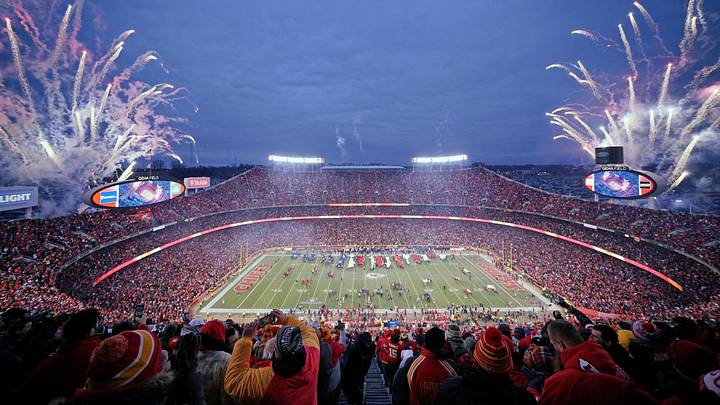
We know that the Kansas City Chiefs will be getting a new stadium in 2030. But could the city potentially miss out on hosting one of the biggest enticements behind building a new stadium in the first place? Will Kansas City actually get to host a Super Bowl if it builds a new, domed Arrowhead 2.0? According to one insider, the answer is most likely going to be no.
Albert Breer from Sports Illustrated heavily downplayed the likelihood that the NFL’s title game would come to Kansas City while speaking on The Dan Patrick Show on Wednesday.
Kansas City’s Super Bowl dream already has a serious obstacle
“Kansas City is getting a new stadium, I would think that they’ll get something for that,” Breer said. “Now, my guess would be it won’t be a Super Bowl, but they are one of these teams that is in line to build a new stadium. Chicago. If they build a dome, and Washington, if they build a dome, they’ll get Super Bowls. With your Clevelands and your Kansas Cities, you're probably looking at getting drafts.”
When asked directly by Patrick whether Kansas City would host a Super Bowl if it built a dome, Breer flat-out said no.
“No, I don’t think so. I just don’t think they have the infrastructure,” he said. "They’ve already hosted a draft, I think they would maybe get another one, but I have a hard time seeing that [hosting a Super Bowl].”
If Breer’s opinion turns out to be correct, and there is no information or whispers from the NFL that it will, it would be a huge blow to Kansas City, both financially and for the city’s reputation as a football town.
The money behind a Super Bowl bid matters here
The Chiefs’ new stadium will cost an estimated $3 billion to build, with the economic benefits of hosting a Super Bowl helping to offset the construction costs and justify the massive expense in the first place.
The lack of a Super Bowl could leave a massive financial shortfall that could impact the entire project’s feasibility. According to a report commissioned by the Bay Area Host Committee ahead of Super Bowl LX in San Francisco, the game was forecast to bring in between $370 to $630 million to the Bay Area. State officials in Louisiana said Super Bowl LIX generated $658 million for New Orleans and attracted 115,000 visitors.
The Kansas City region would miss out on that economic benefit if it didn’t host a Super Bowl. While the city would no doubt push to host other blockbuster events like Final Fours and College Football Playoff games, those don’t bring the same level of revenue.
The aim of hosting a Super Bowl also shapes the very design of the stadium itself as well. The new stadium in Kansas will have to be a dome, and there are minimum capacity requirements to factor in, too—a criterion the Chiefs’ initial stadium proposal fails to meet.
The Chiefs must decide what kind of stadium they’re really building
Meanwhile, Buffalo, another destination that is unlikely to host a Super Bowl, chose to build a new stadium that met none of the Super Bowl criteria. Rather than making concessions to try and host an event that might never come to town, the Bills instead built what they thought was the best stadium for the team and their fans: a smaller, open-air stadium.
Breer’s reasoning for his take highlighted another interesting point surrounding the stadium build, too—namely that the infrastructure and off-field facilities are arguably even more important than the stadium itself.
“You have to draw the line somewhere and I think the experience a lot of people had in Jacksonville 20 years ago, it sort of underscored there is still a certain number of hotel rooms, a certain amount of event space, there’s a certain structure that a city has to have to host one of these,” Breer said.
Breer also said he doesn’t think Cleveland will host a Super Bowl either, even though the Browns are building a new, roofed stadium too, for similar infrastructure reasons. That means the precinct the Chiefs plan on building around their new stadium in Kansas could make or break their dream of hosting the championship game. A proposed “retail district” will have to include accommodation options, and lots of them.
The Royals’ downtown stadium could become a factor as well. If the ballpark precinct downtown includes building new and bigger hotels, that could work in Kansas City’s favor by increasing the region’s total accommodation and venue capacity.
The next four Super Bowl venues are locked in after the NFL confirmed that new Nissan Stadium in Nashville, Tennessee, will host Super Bowl LXIV in 2030. Super Bowl LXI will be in Los Angeles, LXII will be in Atlanta, and LXIII will be in Las Vegas.
Whether Kansas City’s name will be added to that list in the future is yet to be decided, but adding K.C. to the list of future hosts when their new stadium eventually opens might not be a sure thing after all. The phrase “if you build it, he will come” might be true for ghostly fathers at mythical baseball fields in Iowa, but it might not be true for Roger Goodell and the Super Bowl.
 Add us as a preferred source on Google