

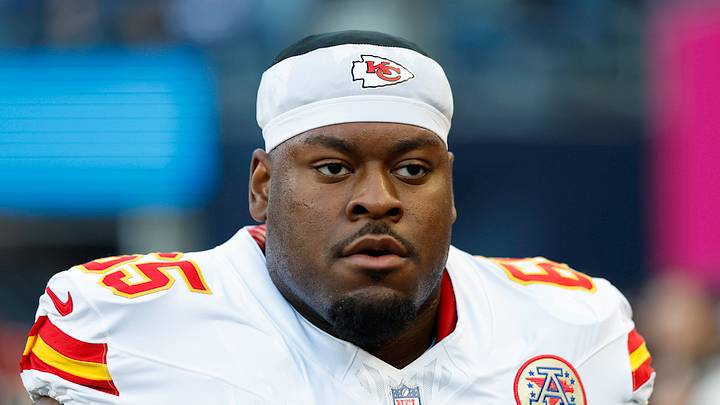
Trey Smith's skills are unquestioned. His strength, his size, his IQ, his technique—it's all part of the Pro Bowl-honored package that the Chiefs happily rewarded with a lucrative extension a year ago. But the best ability in the NFL, they say, is availability. And that's where Kansas City has a problem with Smith.
During K.C.'s most recent loss in Week 12 to the Buffalo Bills, Smith was sent back to the locker room to receive treatment for his most recent injury, a sprained ankle suffered in the fourth quarter. Smith was visibly upset, which isn't at all surprising for such a fierce competitor, especially after he'd just returned from missing a couple of games in the Chiefs' concussion protocol.
Smith even entered the season battling injuries, with a preseason hip injury that held him out of numerous practices and preseason exhibitions. For an established veteran, the loss of reps a month before the regular season began wasn't a great concern. But an unsettling pattern is emerging, making it frustrating for a player who just can't seem to turn a corner in the last year.
The Chiefs had every reason to bet big on Trey Smith
Eighteen months ago, the Chiefs decided to trade away left guard Joe Thuney to the Chicago Bears in an offseason pivot toward keeping Smith around long-term. General manager Brett Veach said the rise in the salary cap allowed K.C. to shift funds around to keep Smith instead of letting him hit free agency after an incredible four-year run with the team as a former sixth-round pick. The extension featured $70 million in guaranteed money over a four-year payout.
The vision was easy to see. The Chiefs already employed Creed Humphrey as the unquestioned greatest center in the NFL. Locking up Smith suddenly gave K.C. the nucleus that would rival the league's best if Kingsley Suamataia could establish himself as a solid replacement for Thuney. Smith had overcome severe medical concerns—blood clots in his lungs (pulmonary embolisms)—to play every game during his rookie contract, so the Chiefs had every reason to lock up his prime seasons.
Two months into a new season, however, Smith suffered a back injury in October 2025 that would require him to miss Week 8. Smith also missed Weeks 13-15 of what turned into a miserable 6-11 campaign. Lost in the full organizational collapse was Smith's injury-affected season. There were simply too many other negative talking points to think too much about the interior lineman as a serious concern going forward.
Smith's injuries are complicating the Chiefs' offensive vision
Nearing the end of another regular season, however, Smith's injury history is starting to add up. The preseason hip injury. The concussion. The ankle injury. Last season's back issues. That Smith was aggrieved on the sideline in Week 12 makes sense. He had such an inspiring climb to become the highest-paid guard in the game after being a day-three draft pick, all built on an incredible body of work over multiple championship seasons. Then his actual body begins to betray him.
It's disappointing for fans as well. Humphrey and Smith should be the reliable cornerstones inside for a revitalized rushing attack with Kenneth Walker and Emmett Johnson in tow. Instead, the Chiefs are rotating backup linemen like Hunter Nourzad and Mike Caliendo next to Humphrey, who's working through his own struggles, as part of a patchwork line already trying to overcome the loss of both starting tackles.
Everyone involved can only hope Smith turns the corner. Injuries are random, and not all point to something bigger. An ankle rolls awkwardly and then heals. A concussion is randomly part of the game. The back and hip injuries are a bit more concerning in the bigger picture, but that's what a training staff is for. The Chiefs can only hope Smith's latest problem is a short-term one, not only for the challenge of playing the L.A. Rams and Cincinnati Bengals in the next two games, but also for a player who takes pride in being a beast in the trenches.
 Add us as a preferred source on Google