

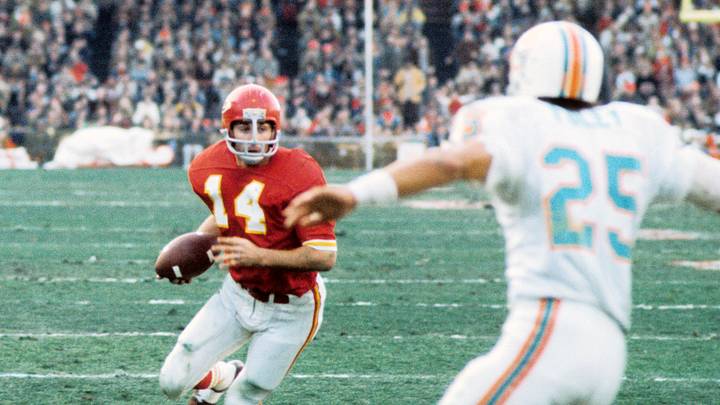
Our journey through Kansas City Chiefs history by number arrives at jersey No. 14 and the fine folks who've worn it. To know the number is to know the spurned heart of the front office, the postseason mastery of the Lizard King, and the incredible versatility of a historic hero. As we continue from 1 to 99, here's a look at the complicated history of No. 14.
The complete history of Chiefs players to wear No. 14
Who Wore It Best? Ed Podolak
Before there was Arrowhead, there was Municipal Stadium, and the last game ever played there was the longest in NFL history. The scene is Christmas Day, 1971. Ed Podolak and the Chiefs hosted the Miami Dolphins in a game that lasted 82 minutes and 40 seconds of actual game time. The Dolphins eventually edged the Chiefs by a final score of 27-24 in double overtime, and while everyone involved was tired, Podolak was especially so.
Podolak set a still-standing record that day with 350 all-purpose yards—85 yards rushing, 110 receiving, 155 on returns—the most ever in a postseason game. He broke the return that should have set up the game-winner, but Jan Stenerud pushed the kick wide right, and Miami escaped on its way to back-to-back titles.
While that was Podolak's finest moment, it also illustrates just how incredibly versatile and valuable he was to Hank Stram and the Chiefs for nine seasons. Podolak led the Chiefs in rushing four times, in receiving three times, and in punt returns three times, and he walked away as the franchise's second-leading rusher with 4,451 yards and 34 touchdowns. When you add in his 288 catches and his return yards, and he finished with 8,178 combined yards, second-most in team history at the time. Podolak was inducted into the team's Hall of Fame in 1989.
The Lizard King: Sammy Watkins
Five games, 24 catches, 477 yards. All in the postseason.
It's easy to look at the overall production for Sammy Watkins' three seasons in K.C. and question the impact. Despite a fairly hefty price tag (at the time), Watkins never broke the 700-yard barrier or caught more than 3 scores in a single year. His regular-season totals look like a single elite season—129 catches, 1,613 receiving yards, 8 scores—instead of a three-year span. But health was always an issue, and the Chiefs knew that going in.
What matters most is how Watkins showed up in the clutch, and he did that time and again. It's in the 38-yard grab that set up the go-ahead touchdown in their Super Bowl LIV win over the 49ers. The postseason numbers speak for themselves, and K.C. doesn't earn its first ring in the Andy Reid era without him. If not for Podolak, Watkins would be the choice as the best to wear No. 14.
The Never Again: Todd Blackledge
If you've ever wondered exactly why the Kansas City Chiefs failed to invest a first-round pick in a quarterback for so long before trading up for Patrick Mahomes, Todd Blackledge is your answer—or at least part of it.
The Chiefs waited 34 years—thirty-four!—between taking first-round QBs, a painful stretch for K.C. fans hungry for a homegrown franchise face. Blackledge was the team's first-round choice in the 1983 NFL Draft at No. 7 overall. Six quarterbacks were chosen in that first round, and the Chiefs picked the worst one, and while John Elway was already off the board, Dan Marino and Jim Kelly were there for the taking. Heck, even Ken O'Brien would have been a nice takeaway.
Blackledge averaged fewer than five starts per season in his five-year career in K.C. Despite the investment, Bill Kenney held onto the starting QB role for most of the '80s, and the Chiefs were left to wonder how they struck out again after taking Steve Fuller in the 1979 NFL Draft's first round as well. Back-to-back misses sent the Chiefs into a depression that required decades to get over.
That's the behavior of a team that had been burned one too many times, the broken heart that refuses to love again. And that's Blackledge's legacy in Kansas City.
The Punt God: Matt Araiza
The current wearer of No. 14 is Matt Araiza, the punter that San Diego State fans nicknamed "Punt God" for his record-setting leg. His path to Kansas City was complicated—he was drafted by Buffalo in 2022, released after criminal charges were filed, then signed with K.C. after those very charges were dropped.
On the field, Araiza has been a steady performer with some spectacular showings. He averaged a whopping 51.8 yards on 6 punts in Super Bowl LIX against the Philadelphia Eagles, but his net yards/punt of 41.3 was the exact league average during the regular season in '25. He's back again on a one-year deal.
The QB/DB: Bobby Ply
Bobby Ply wore No. 14 from the Dallas Texans days through the mid-'60s, and he owns two AFL championship rings—one with the 1962 Texans, another with the 1966 Chiefs—to show for his efforts. He made the professional leap as a quarterback out of Baylor, but Hank Stram moved him to defensive back instead. The move paid off quickly, since Ply picked off seven passes as a rookie in 1962. Ply would finish his career with 9 total INTs, and decades after his retirement, he became one of the founding members of the Chiefs Ambassadors.
Et Cetera
- Demarcus Robinson, WR - Briefly wore the number before switching to No. 11, which we've already covered here.
- Hunter Enis, QB - A quarterback from the Dallas Texans days (1960) whose name is the most interesting thing about him.
- Cornell Powell, WR - The former Clemson star stuck around for four seasons as a former fifth-round selection (2021), but his impact was minimal.
 Add us as a preferred source on Google