

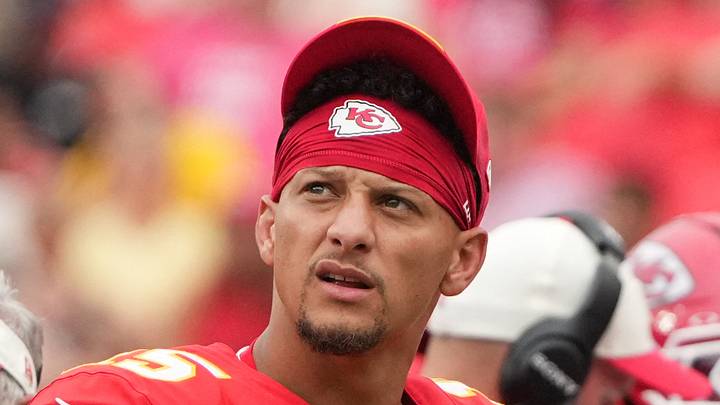
When your quarterback is Patrick Mahomes, it becomes very easy to glaze over this topic in the preseason. In other years, the one burning question about Mahomes might have been “Is he getting enough sleep with a new baby in the home?” or “Is his arm okay, with the weight of all of those Super Bowl rings on his hand?” But in 2026, questions abound at this position, probably more than any other year.
December 14, 2025. With the Chiefs’ playoff hopes down to a single thread, Mahomes and the Chiefs were driving, down 3 against the Chargers and just inside the 2-minute warning. Mahomes rolled to his right, and tragedy struck: suddenly, the league’s greatest asset lay on the turf, writhing in pain. Twenty-four hours later, the Chiefs were mathematically eliminated from the postseason, and their star quarterback was in surgery with a torn ACL and LCL. Backups Gardner Minshew and Chris Oladokun closed out a season to forget, and the team staggered to the season’s end.
Turning the page into 2026, Mahomes and Oladokun return. The Chiefs also added former first-rounder Justin Fields in exchange for a 2027 sixth-round pick and spent their first draft choice on a quarterback since the team’s selection of Mahomes in 2017, picking LSU’s Garrett Nussmeier in the seventh round of this year’s NFL Draft.
Though Mahomes is coming off the most serious injury of his career (and there have been a few), no one close to the team has ever had serious doubts about the star quarterback’s remarkable ability to recover. But a season-ending injury does lead to further discussion about the status of the Chiefs’ All-Pro signal caller, which leads us to our One Burning Question:
How can the Chiefs protect Mahomes coming off the knee injury?
Mahomes’ remarkable plasticity dates back to 2019, when he returned from a dislocated knee after just 2 games. The 30-year-old has also dragged his team through playoff runs after getting choked out during the Divisional Round against the Browns in 2021 and running one-legged from the Divisional Round to the Super Bowl MVP in the 2022/2023 season. He certainly has a reputation for having quick recovery times, but this is the biggest injury of his career to date. Thus far, Mahomes has met or exceeded every expectation, taking first-team reps in training camp while running and cutting. His biggest struggle in training camp has been trying to figure out how to play with the clunky knee brace, as he has been spotted wrestling with it on the sidelines in multiple settings.
A better running game can take pressure off Mahomes
If protecting Mahomes involves a checklist, one of the boxes has already been marked off with the upgrades in the running game. Last year’s team featured a run game that no one feared or really even needed to prepare for (nor did it offer much help in terms of pass protection). Without a viable threat in the backfield, teams were able to focus all of their efforts on stopping Mahomes and the Chiefs’ passing game.
That will change in 2026. Super Bowl MVP Kenneth Walker III was added via free agency, as were veteran third-down back Emari Demercado and fifth-round draftee Emmett Johnson. Walker gives the Chiefs a valid threat in the run game and will keep defenses honest. He won’t necessarily be a bellcow, but he won’t have to be—nor would he be as effective. His explosiveness on a play-by-play basis will help ensure that opponents are taking the time to respect the Chiefs’ run game with fidelity, which in turn can open things up for Mahomes and the passing game.
Most importantly, it helps keep the Chiefs from getting themselves into a position in which Mahomes feels he has to drag the offense kicking and screaming into the end zone, like he has in recent history. Demercado has a reputation as a stellar pass blocker, and that has indeed shown up in training camp.
Specific to the passing game, there are ways in which head coach Andy Reid and offensive coordinator Eric Bieniemy can further insulate Mahomes from injury (and, to some degree, from himself).
Finding the right balance between shotgun and under center
One way is by being intentional with how they employ the shotgun vs. lining up with Mahomes under center. It’s been unpacked dozens of times, each from their own angle, but here’s the interesting thing about this topic as it pertains to the Chiefs. Reid and Bieniemy can best protect Mahomes via play-calling by putting him under center, but Mahomes can best protect himself from the shotgun.
Particularly given Mahomes’ tendency to drop back too far, allowing defensive ends to pin their ears back and tee off, Reid and Bieniemy can help keep Patrick healthy by going under center because it will keep defenses’ eyes shifting all over the backfield. The offense can open up play action and misdirection, which will help keep Mahomes’ jersey clean. Defensively, teams can make reads much easier while the offense is in the shotgun, especially with the Chiefs’ RPO offense having been studied endlessly for years.
However, Mahomes himself can keep himself healthier from the gun because it limits his planting, pivoting, and stretching. The Chiefs use the RPO the most in the NFL, so it is hard to imagine that it will be completely wiped from the playbook, nor should it be, given Walker’s impressive 4.8 yards per carry in his career on RPOs. If the Chiefs see nearly as many light boxes as they have in the past, Walker should feast either way.
More tight ends could give the Chiefs another answer
Another thing Reid and Bieniemy will do is employ more sets with two or even three tight ends. Reid has much experience with these concepts, both in Philadelphia and in his early years with the Chiefs. Though the Chiefs do not exactly have a stable of prolific tight ends, they do have a great start in future Hall of Famer Travis Kelce. Noah Gray is coming off one of his worst seasons as a pro (21/178/0 on 37 targets), but the Chiefs are optimistic he will bounce back. Jared Wiley and Jake Briningstool are prospects at this juncture, but if either can pose a viable threat, the Chiefs could be cooking with gas in 12 and 13 personnel sets.
The reason is that it can exploit smaller defenses and give the Chiefs the most flexibility in the run/pass option game. If teams choose to take linebackers off the field against Mahomes, Reid and Bieniemy can scheme more run-heavy concepts. If defenses try to move up against Walker and company, the offense can find one-on-one mismatches.
The return of Bieniemy not only brings back “the a-word” in Kansas City, but he also brings a year of experience with Bears head coach Ben Johnson, whose offense was in 13 personnel the fifth-most in the league in 2025, with 94 snaps. If the Chiefs can properly protect their star quarterback with formations, schematic creativity, and unpredictability, the sky is the limit in 2026.
 Add us as a preferred source on Google